A Conspiracy of Silence?
In 2019, Volodymyr Zelensky knelt before the grave of his grandfather, Semen Zelensky, a decorated World War II veteran who fought against Nazi Germany in the ranks of the Red Army. In May 2026, he knelt before the grave of Andriy Melnyk (1890-1964), a Ukrainian who collaborated with the Nazis.
Few of the 73 percent of Ukrainians who voted for Zelensky in the presidential election seven years ago could have imagined such a transformation. For some, it may simply reflect the evolution of Ukraine’s national narrative in wartime. For others, it may feel like a betrayal of the values and historical memory that Zelensky once appeared to embody.
One thing, however, remains certain: the history and memory of the Second World War continue to occupy a central place in Ukrainian society today. They remain not only a powerful source of national mobilization, but also a persistent fault line—shaping political debates, competing identities, and deepening divisions inside the country and with its partners.
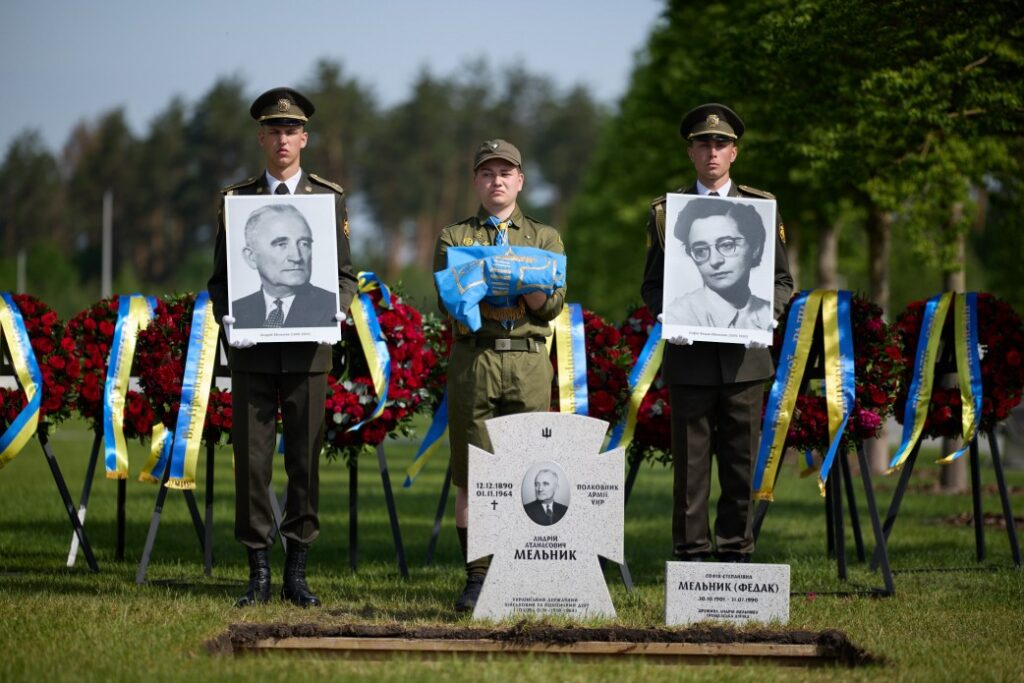
This became particularly evident in late May against the backdrop of two developments. The first was the state reburial of Andriy Melnyk, leader of the Organization of Ukrainian Nationalists (OUN), in Ukraine, with full military honors. The second was the decision to name the Special Operations Center of the Special Operations Forces of the Armed Forces of Ukraine after the Heroes of the Ukrainian Insurgent Army (UPA).
Melnyk’s reburial ceremony took place on May 25 at the National Military Memorial Cemetery outside of Kyiv, and was attended by President Zelensky, the prime minister, government officials, politicians, clergy, and some members of the public. Also in attendance were soldiers from the Azov-rooted Third Assault Brigade of the Third Army Corps. Their presence was particularly revealing. Of the more than 120 brigades and a military force numbering roughly one million personnel, this unit was invited to participate in the ceremony. That choice was unlikely to be accidental. The Third Assault Brigade has long presented itself as an ideological heir to the traditions of the OUN and UPA, making its participation symbolically consistent with the broader message of the event.
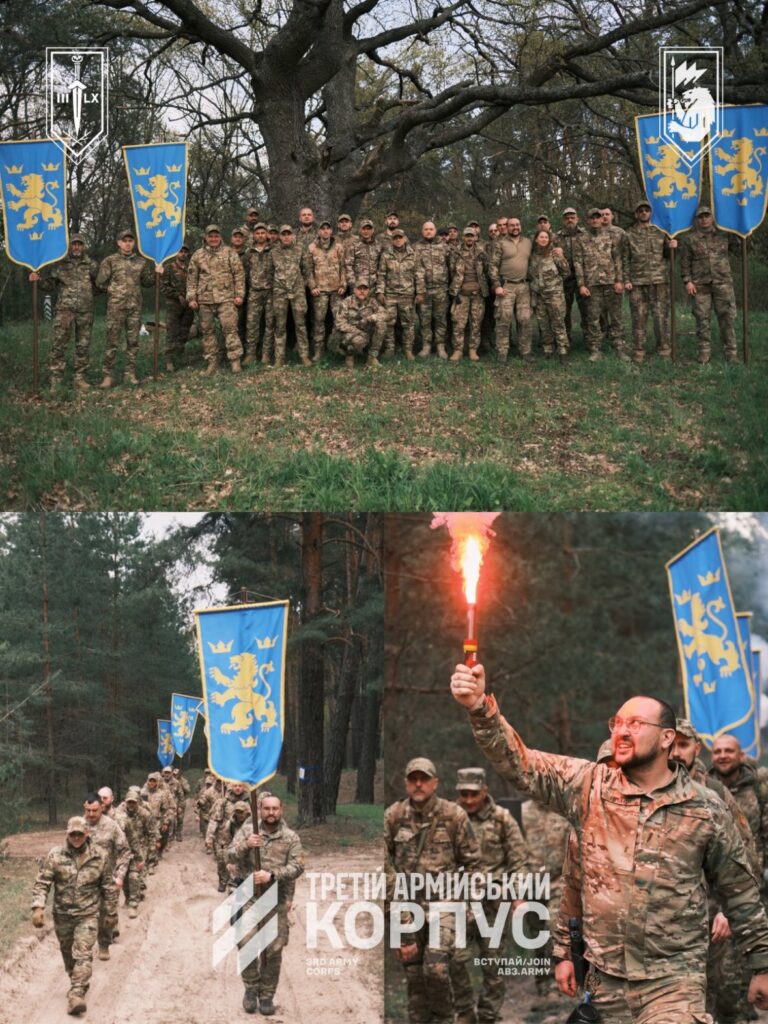
Equally noteworthy is the brigade’s own approach to historical memory. In 2023, the Third Assault Brigade staged an exhibition at the Kyiv History Museum in which active-duty soldiers reenacted iconic photographs of Waffen SS Galicia fighters. The tradition of commemorating the Division has now spread to other brigades incorporated into the Third Army Corps, a formation built around the organizational model and culture of the Third Assault Brigade. This year, in April, the Third Army Corps marked the anniversary of the Waffen-SS Galicia Division with speeches, a concert, and a torchlight march, while paying absolutely no attention to May 8, Ukraine’s official day commemorating the defeat of Nazism. The connection is significant: Melnyk himself actively supported the creation of the Waffen SS Galicia Division in 1943.
Another detail deserves attention. Oleksandr Alfiorov, the current head of the Ukrainian Institute of National Memory, was also present at Melnyk’s reburial. Before assuming his current position, Alfiorov served as an officer in the Third Assault Brigade. It is therefore plausible that he played a role in facilitating his former comrades’ participation in what was, by any measure, a highly symbolic state ceremony.
Melnyk’s reburial drew criticism from Israeli officials and Yad Vashem, who reminded Kyiv of Melnyk’s collaboration with Nazi Germany. Renaming a military unit after “UPA heroes” also provoked objections from Poland, which holds the UPA responsible for the genocide of Poles during World War II. According to Polish Institute of National Remembrance estimates, Polish deaths numbered at least 120,000.
Polish President Karol Nawrocki reportedly moved to strip President Volodymyr Zelensky of the Order of the White Eagle, Poland’s highest state distinction. Marcin Przydacz, head of the International Policy Bureau, insisted that Zelensky should personally call the Polish president and apologize for his decision. Meanwhile, former Polish ambassador to Ukraine Bartosz Cichocki returned the Ukrainian Order of Merit that Zelensky had awarded him in 2022. In another symbolic gesture, the Lublin City Council removed the Ukrainian flag from its building, where it had flown continuously since 2022.
The Ukrainian side was quick to share responsibility with the military personnel involved. Foreign Ministry spokesperson Heorhii Tykhyi stressed that the decision to name the unit after the “Heroes of the UPA” had originated with the soldiers themselves, who, he argued, “certainly had no intention of offending the friendly Polish people.” According to Tykhyi, for these servicemen, the UPA’s legacy symbolizes only resistance to Moscow’s imperial policies and is “in no way directed against Poles.” Servicemen from other units amplified the controversy on social media by circulating the Ukrainian nationalist slogan “Our land, our heroes.” The essence of this slogan is that Ukrainians, as a sovereign nation, alone have the right to decide whom they honor as their national heroes. No outside actor—whether foreign governments, international organizations, or critics abroad—can dictate those choices, even when they provoke discomfort, outrage, or shock among others.
Whose National Pantheon?
Andriy Melnyk was laid to rest at Kyiv’s National Military Memorial Cemetery. In the future, his remains are expected to be transferred to the National Pantheon of Heroes, a memorial complex that Ukrainian officials have repeatedly promised to establish. This is not merely a matter of burial arrangements. It is a powerful symbolic act that places Melnyk within the official pantheon of figures deemed worthy of national commemoration and public honor.
This inevitably raises a fundamental question: who will decide, and according to what criteria, which historical figures deserve a place in this Pantheon? And why is Melnyk—one of the most controversial figures in modern Ukrainian history—among the very first to be honored in this way? Why was this organized now? What was the personal role of Zelensky in this?
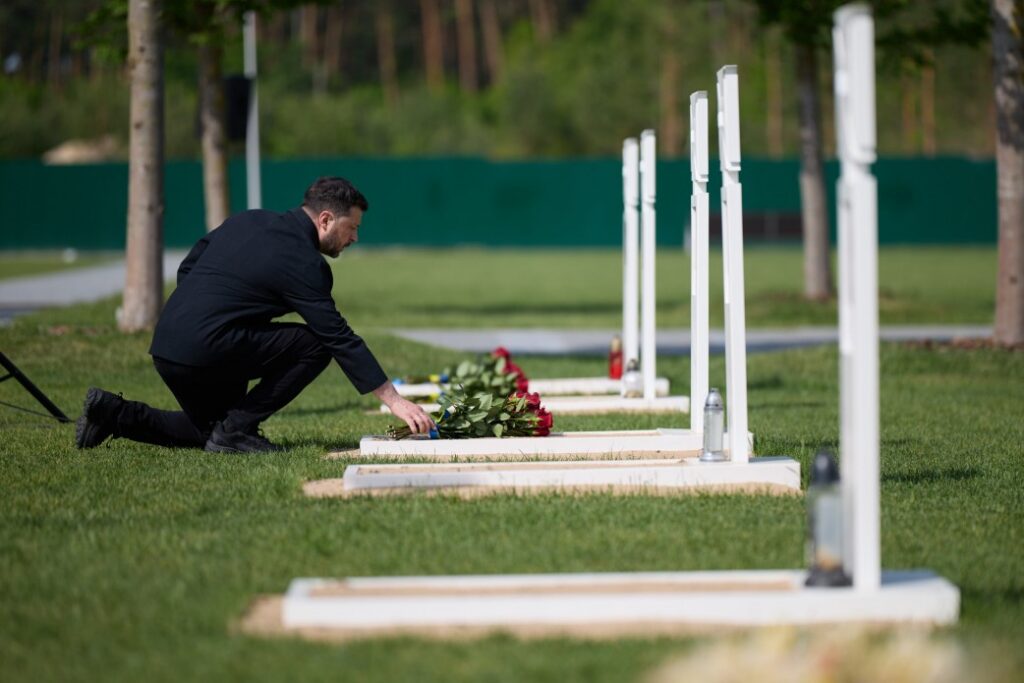
The irony is difficult to miss. Melnyk, a man widely criticized for his collaboration with Nazi Germany, is being honored with state ceremonies under a president of Jewish heritage. This reburial did not take place under President Viktor Yushchenko, whose fascination with the history of the OUN and UPA led him to award the title of Hero of Ukraine to another OUN leader, Stepan Bandera. Nor did it occur under President Petro Poroshenko, who successfully pushed for legislation recognizing members of the OUN and UPA as “fighters for Ukraine’s independence.” Instead, it materialized under President Zelensky, who once appeared politically and culturally distant from that nationalist agenda. Zelensky built much of his career as a comedian satirizing Western Ukrainian nationalism and its leaders. His embrace of a figure such as Melnyk therefore represents a remarkable departure from the image and political instincts that once defined him.
Another striking detail is that the decision to rebury Melnyk was made without public hearings or meaningful consultation with historians and other experts. The government has failed to explain to the wider public why Andriy Melnyk—a man who supported Nazi plans for constructing a “new order in Europe,” and whose followers served in auxiliary police units in Nazi-occupied Ukraine—should be incorporated into the National Pantheon of Heroes. These auxiliary policemen hunted Jews in hiding, guarded ghettos, escorted Jews to execution sites, and participated in mass shootings. Yet the question of whether such a legacy is compatible with democratic values has been conspicuously absent from public discussion.
Nevertheless, the government has already signaled that other members of the OUN will soon be inducted into the National Pantheon of Heroes, including Yevhen Konovalets and, quite possibly, Stepan Bandera—the iconic figure of Ukrainian nationalism. The direction of travel is unmistakable. The Zelensky government appears to be placing particular emphasis on the leaders of the OUN and UPA because, within Ukraine’s contemporary wartime discourse, they have come to embody the ideal of uncompromising resistance to Soviet rule. In this reading, their historical legacy offers a powerful symbolic resource for resistance to ongoing Russian aggression.
Within such a militarized and hero-centric narrative, there is little room left for empathy toward the victims of the OUN and UPA. The focus on heroism, sacrifice, and national resistance tends to overshadow the suffering of the tens of thousands of Polish, Jewish, and other “enemy” neighbors—including women, children, and the elderly—who were brutally killed in the pursuit of an “ideal Ukraine.”
As a result, historical memory risks becoming increasingly selective. The latest example of this is an exhibition by the Ukrainian Institute of National Memory marking the anniversary of World War II this year, in which the history of the OUN and UPA appears exclusively in the context of their struggle for Ukrainian statehood. Notably absent, however, is any mention of their involvement in anti-Jewish violence, including the 1941 Lviv pogrom, their complicity in the Nazi Holocaust, or the murder of Jews in hiding. The exhibition is equally silent about the mass killings of Polish civilians in Galicia and Volhynia. Such omissions are hardly accidental. The Institute’s mission is not to confront uncomfortable historical truths but to construct and sustain a heroic national myth.
Screaming Silence
Equally striking is the fact that the reburial of Andriy Melnyk has drawn no criticism from Ukraine’s liberal intelligentsia. Public debate has focused on the burial site, the monument’s design, and other procedural details, but not on the reburial itself or the broader question of whether Melnyk belongs in a national pantheon of heroes. That silence is both revealing and troubling. It suggests that issues that would once have provoked vigorous public debate are increasingly taken for granted. The absence of a serious discussion regarding the appropriateness of elevating Melnyk to the status of a national hero raises important questions about the narrowing boundaries of acceptable debate on memory in wartime Ukraine. What is happening in Ukraine’s intellectual circles in this regard can be described as a conspiracy of silence.
The foundations for this shift were laid in the aftermath of the Maidan Revolution in 2013 and the adoption of Ukraine’s 2015 memory law. This law officially recognized the OUN and UPA as “fighters for Ukraine’s independence,” while Article 6 effectively discourages and criminalizes criticism of their legacy, which it deems disrespectful to the memory of the independence fighters and an affront to the dignity of the Ukrainian nation.
The legislation was enacted in the wake of Russia’s annexation of Crimea and at the height of the war in the Donbas. Its architects made little secret of their intentions: historical memory was to serve as an instrument of national mobilization in the face of external aggression. At the time, critics warned that the laws could narrow the space for free debate and make it increasingly difficult to engage critically with the complex and controversial history of the OUN and UPA.
Those concerns have only become more pronounced since Russia launched its full-scale invasion in February 2022. As the war has intensified, so too has the tendency to frame history through the lens of national resistance and military sacrifice. In such an environment, challenging heroic narratives becomes ever more difficult, while nuanced discussions of historical responsibility, collaboration, and violence are increasingly pushed to the margins.
Since then, a growing number of Ukrainian intellectuals have embraced a form of self-censorship. Reluctant to “rock the boat” during wartime, many have argued that debates about the country’s difficult and contested past should be postponed until after victory. The consequences of this mindset extend well beyond historical memory. Within such a framework, criticism of the government—even when constructive, measured, and offered in good faith—is increasingly viewed with suspicion. Rather than being seen as a normal and necessary feature of democratic life, dissent is often portrayed as undermining national unity and, at times, as bordering on an act of disloyalty.
In a country at war, the expectation is no longer simply that one be an intellectual. Increasingly, one is expected to become a “Ukrainian intellectual” — a “Ukrainian voice to the world,” tasked with representing the nation’s cause on the international stage. In practice, however, this role often comes with implicit obligations. The intellectual is expected not merely to interpret reality, but to reinforce the state’s wartime narrative and contribute to the broader project of national mobilization. The boundary between independent critical inquiry and patriotic advocacy becomes increasingly blurred. The result is a public sphere in which critical reflection on the nation’s past is progressively subordinated to the imperatives of national unity, political loyalty, and wartime necessity. Questions that complicate dominant narratives are often deferred, softened, or left unasked altogether.
Others genuinely believe that, in a time of what is widely perceived as an existential war, Ukraine requires unifying historical myths capable of rallying society around the defense of statehood. As a result, some Ukrainian scholars, public intellectuals, and educators have become active participants in constructing a heroic national narrative centered on the OUN and UPA. Rather than interrogating simplified historical narratives, selective remembrance, or politically convenient silences, they have often helped legitimize them in the name of national unity. The consequence is a growing convergence between scholarship, memory politics, and state interests. One notable example is Yaroslav Hrytsak, a professor at the Ukrainian Catholic University, who commented on Stepan Bandera—the fascist icon of Ukrainian nationalism and leader of the OUN—in the following terms: “The myth of Bandera is a myth about Ukraine’s resistance to its enemy. But as a citizen, I will not touch this myth, especially during wartime. Because the contemporary myth of Bandera is not toxic.”
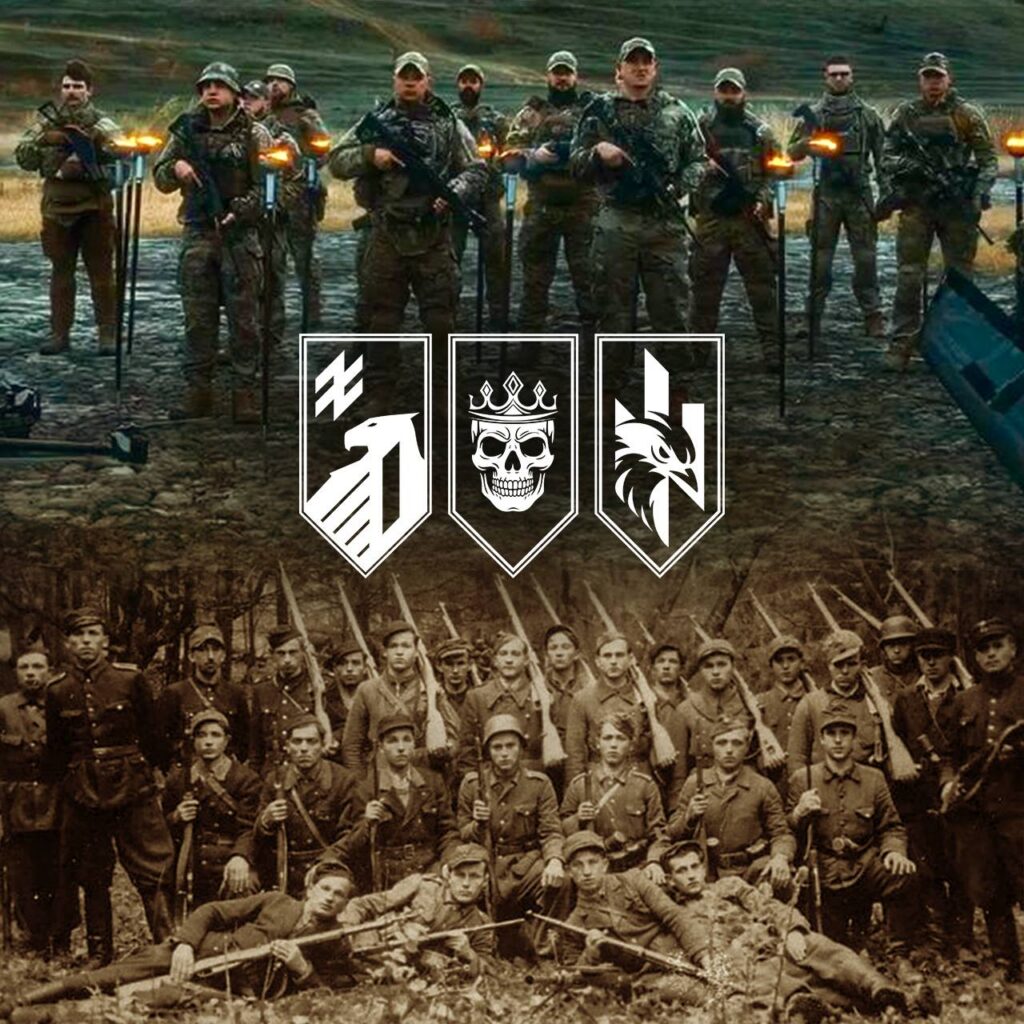
Another reason for the silence is that the OUN and UPA myth has become embedded in today’s Ukrainian military culture. The slogan “Different centuries, the same enemy” has turned the UPA into a historical mirror of today’s war against Russia. As a result, criticizing the UPA is often treated as criticizing Ukraine’s Armed Forces themselves—the most trusted institution in the country. This helps explain why Ukrainian scholars have largely ignored the fact that military units bear the names Nachtigall and Roland—Abwehr battalions formed from OUN members in 1941 that participated in the Nazi invasion of the Soviet Union, anti-Jewish violence, and anti-partisan operations.
Another segment of Ukraine’s intellectual elite remains silent not because it agrees with the ethnonationalist turn in memory politics, but because it fears the consequences of being perceived as disloyal. In a society at war, where self-appointed patriots in the rear are constantly searching for a “fifth column” and alleged collaborators, it is all too easy to become a target.
I know this from personal experience. After I began researching gender-based violence committed by the OUN and UPA, I faced bullying, publication bans, threats to my job, antisemitic abuse, death threats, and harassment directed at both my family and me. The accusation was always the same: that I was “working for the Kremlin” or spreading “Russian propaganda.” One of my academic articles on rape and other forms of violence against women committed by OUN and UPA members was even cited by the extremist website Myrotvorets as evidence of my alleged hostility toward Ukraine. What is most revealing is the silence of my colleagues. Few have condemned the use of academic research as a tool of political intimidation. Fewer still have defended the right of historians to investigate uncomfortable truths. My case is not unique.
Another target in the search for “internal enemies” in wartime Ukraine has been historian Heorhii Kasianov. His acclaimed book Ukraine and Its Neighbors: Historical Policy, 1987–2018 was recently placed on an official list of publications deemed harmful to Ukraine’s independence by the State Committee for Television and Radio Broadcasting, citing information from the Security Service of Ukraine. The stated reason was that the book allegedly promotes “historical relativism” that “undermines national identity” and “discredits state memory policy,” particularly regarding the role of the OUN and UPA in Ukrainian statehood.
Anyone who dares to raise uncomfortable questions about Ukraine’s memory politics today risks being accused of serving Russian propaganda or undermining the country’s war effort. The irony is hard to miss. Public outrage is often directed not at those who provide ammunition for the Kremlin’s narrative about the need to “denazify” Ukraine, but at those who draw attention to the problem in the first place.
In this inverted moral landscape, criticism itself becomes the offense. Those who question controversial commemorative practices are denounced as disloyal or irresponsible, while those who normalize them are praised as patriots. The debate is no longer about the substance of the argument, but about the presumed motives of the person making it.
Perhaps most troubling is the response of a significant part of Ukraine’s intellectual elite. The traditional role of intellectuals is not to echo official narratives but to scrutinize them, to ask difficult questions when others prefer silence. Yet many have chosen to align themselves with the state’s agenda. Rather than defending pluralism, open debate, and critical inquiry, they have increasingly participated in policing dissent and marginalizing voices that challenge the growing dominance of ethnonationalist interpretations of Ukrainian history.
This development is understandable, at least in part. Faced with a brutal Russian invasion, many intellectuals feel a moral obligation to defend their country and strengthen its position in the information war. But good intentions do not eliminate political consequences. In seeking to protect Ukraine from external threats, they may also be helping domestic elites consolidate power and reinforce illiberal tendencies at home.
Ukraine may well survive this war. The more consequential question is what kind of country will emerge once the fighting ends. If critical thought continues to be sacrificed on the altar of national unity, Ukraine risks winning the struggle for survival while surrendering part of the democratic future it claims to be defending.