Gaza and the Ghosts of Leningrad
The Germans intentionally orchestrated a horrific famine in Leningrad during the Second World War. The Israeli siege of Gaza is following the same logic.
Israel is starving Gaza. A population of 2.1 million is on the brink, experts warn, of mass starvation leading to “widespread death.”
Israel is weaponizing hunger in a military campaign that more and more humanitarian organizations are classifying as genocide. More than 200 aid groups, including a number in Israel, have called on the Israelis to follow international law and restore aid. According to the United Nations, since May 21, Israeli forces (and their allies) have killed some 1400 Palestinians who were desperately seeking food aid.
But Israeli officials continue to deny realities on the ground. Rejecting evidence presented by hundreds of experts, thousands of photographs, and statements from his own officials, as recently as July 28 Prime Minister Benjamin Netanyahu declared, “There is no policy of starvation in Gaza, and there is no starvation in Gaza.”
Israeli authorities have blamed Hamas, the UN, and the residents of Gaza themselves for the lack of food. Proponents of the siege of Gaza have claimed that images of emaciated and malnourished children are fake—or that the dead and dying have suffered, not from Israel’s blockade of food and other aid, but from “genetic disorders.” In the case of the 18-month old Mohammed Zakaria al-Mutawaq, the New York Times added an editor’s note to the photograph of his emaciated body explaining that he had “pre-existing health problems.”
None of this has transpired in secret. The UN began issuing warnings about starvation in Gaza in early 2024. By June 2024, 9 out of 10 children there suffered from severe food poverty according to UNICEF.
Since the imposition of a total Israeli blockade in March 2025, a steady stream of images of starving children has reached every corner of the globe. Meanwhile, Israeli authorities have repeatedly declared their intent to starve Palestinians in Gaza. Critics in Israel such as B’Tselem (The Israeli Information Center for Human Rights in the Occupied Territories) have also recognized that their government is creating a famine.
In response to domestic and international criticism—including from a few Democratic members of the US Congress, Israel has made symbolic airdrops of aid. But the policy of using food as a weapon remains in place, and the world seems powerless to stop it.
Famine without Precedent?
Why the international community is paralyzed in the face of this cruel killing spree is a puzzle. That the United States and most European states have shielded Israel politically, diplomatically, and militarily from any accountability and even supported the genocide by continuing to provide Israel with weapons is one factor.
Another reason relates to our incapacity to come to terms with this manner of killing in 2025, especially when it is being carried out by a state founded in the wake of the Holocaust. Disinformation and Israeli censorship play a role. At the same time, given the available evidence, which is abundant, we still lack the imagination to understand what is happening in Gaza, in part, because it appears to be so unprecedented. Siege warfare is an ancient form of killing that one rarely encounters in the modern world.
There are exceptions, of course. For 43 months between 1992 and 1996, Sarajevo endured a siege imposed by Serb nationalist forces led by Ratko Mladic, now serving a life sentence in the The Hague for his role in killing civilians in the capital of Bosnia and the murder of some 8,000 Muslim men and boys at Srebrenica. During the same period, Russian forces razed most of Grozny in two vicious campaigns, in 1994-1995 and 1999-2000.
Beyond the Balkans and the North Caucasus, these events are mostly a distant memory in our collective consciousness. When Grozny is recalled today, it tends to be invoked to critique Russia’s ongoing war in Ukraine.
By contrast, the 872-day siege of Leningrad by the German military during the Second World War is—outside of Russia—rarely invoked as a lesson for modern politics, precisely because of the singularity of the Nazi system and its unique capacity to inflict unimaginable horrors on its victims.
But it is precisely the exceptional character of the Leningrad blockade that makes comparisons with Gaza so revealing—and troubling. Despite important differences, juxtaposing the two episodes brings to light many similarities.
Viewed through a comparative lens, Gaza appears less like a “humanitarian crisis” or a generic “tragedy,” to quote the August 1 cover of Time magazine, than a massive war crime that broadly conforms to German patterns of atrocities. In its conception and the language used to justify it, the Israeli starvation of Gaza has a precedent in the Nazi treatment of Leningrad. A closer look at the two moments brings into stark relief the relationship between this intentional famine and Israeli war aims.
“The idea is to put the Palestinians on a Diet”
Comparing these two sieges highlights key distinctions that makes the plight of Gaza appear all the more shocking. The German army that invaded the USSR was the largest invasion force in human history; and everything about the battle for Leningrad took place on a larger scale.
Begun soon after Adolf Hitler launched “Operation Barbarossa” in June 1941, the German siege of the city killed between 1.6 and 2 million people. Some 800,000 civilians died by starvation, disease, exposure, and injuries caused by bombardment of the city. However, the Germans and their Finnish allies were never able to permanently cut off all supply routes and communication channels to the outside. Some supplies could still be transported across Lake Ladoga.
In Gaza, by contrast, Palestinians have had to contend with periodic Israeli border closures and restrictions on imports of food and other necessities since the 1990s.
Israeli control of Gaza’s borders tightened after Israel withdrew its military and settlers from the territory in 2005. As an Israeli official explained in 2006, “The idea is to put the Palestinians on a diet, but not to make them die of hunger.” Blockaded by land, sea, and air, by 2007, Palestinians regularly complained of living in “the world’s largest open-air prison.”
Following the Hamas takeover of Gaza in 2008, Israel cut off humanitarian assistance, including food, electricity, and fuel. Between 2007 and 2010, Israel restricted the entry of food, while monitoring a daily “calorie count” for each inhabitant. A continuous blockade of 15 plus years meant that, on the eve of the Hamas attack on Israel of October 7, 2023, some 62% of Gazans needed food assistance.
The duration of this blockade is one significant difference between the sieges of Gaza and Leningrad; the international legal context is another. In the aftermath of the Holocaust and other atrocities against civilians in the Second World War, a new legal architecture emerged with the goal of prohibiting genocide and protecting civilian populations from the kind of violence that people across Europe suffered under German occupation.
The Geneva Convention of 1949 (Article 54 of Additional Protocol 1) prohibits “starvation of civilians as a method of warfare.” Similarly, the International Criminal Court treats as a war crime the “starvation of civilians as a method of warfare by depriving them of objects indispensable to their survival, including willfully impeding relief supplies as provided for under the Geneva Conventions.”
Already in November 2024, the ICC issued arrest warrants for Netanyahu and Yoav Gallant, the Israeli Minister of Defense, for their conduct of the war in Gaza, including for “crimes against humanity and war crimes” and “the war crime of starvation as a method of warfare.”
Nonetheless, parties to the Gaza blockade, namely Israel and its allies in the US and Europe, continue to flout international law even as more and more images of starving and dying Palestinian children circulate around the globe.
The contrast with Leningrad, where the Nazis tried to conceal their crimes, could not be greater. As many commentators have pointed out, this famine is being broadcast live —and defended by Israelis and their allies—around the world. In August 2024, Finance Minister Bezalel Smotrich even asserted that it would be “just and moral” to starve two million people in Gaza to secure the return of Israeli hostages, if only “the world” would allow it.
As the historian Tarik Cyril Amar has observed, “we have not yet seen a genocide committed in broad and global public daylight, watched close-up in real time via traditional and social media, proudly announced and boasted about by the perpetrators, and so massively and obstinately supported by a West that cannot stop claiming ‘value’ superiority.”
“We are compelled to treat the city and its entire population as a military target”
Parallels between the siege by the Germans at Leningrad and the Israelis in Gaza are even more striking. Consider the rationale offered for the collective punishment of indiscriminate, mass starvation. Revisiting the original German documents from 1941 that recorded the thoughts of senior Nazis and Hitler himself makes for difficult reading in 2025.
The Germans framed Operation Barbarossa as an existential struggle. In announcing the invasion to German troops, Hitler cast it as an essentially defensive measure—to prevent encirclement of the Reich and to “save European culture and civilization” from the “Jewish-Bolshevik leadership in Moscow.” Germany’s mission was to defend Europe against “Asiatic barbarism.”1
In the USSR, unlike in Western Europe, the head of the 17th Army of the Wehrmacht stressed in September 1941, “the German people is in a life or death fight against the Bolshevik system.” The war would end “only with the destruction of one or the other” people. It followed that “Compassion and softness toward the population is completely out of place.” The soldier’s task was the “merciless and complete destruction of the enemy.”2
German forces confronted a dilemma in Leningrad. The birthplace of the October Revolution, it was a vast city with a population of some 2 million. German officials debated whether or not they should attempt to capture it and take responsibility for feeding its population. Or should they impose a blockade and risk starvation and the spread of disease? Would German soldiers have to fire on women and children who might escape seeking food?
One proposal involved, for the purposes of propaganda, making a fake offer to work with US President Roosevelt to provide safe passage for the evacuation of the city’s population and resettlement in the US or elsewhere. Another plan was to“hermetically seal” the city and bomb it until, “via terror and the onset of hunger,” some people were permitted to relocate to the interior of Russia. Besieged by German and allied Finnish troops, the rest of its inhabitants would be left to the forces of winter. The consensus view was that, “We are compelled to treat the city and its entire population as a military target.”
Having called repeatedly for Soviet cities to be “leveled” (dem Erdboden gleich machen), Hitler clarified German policy in October. They would accept no surrender of the city; and no German lives were to be sacrificed taking Leningrad or Moscow. Anyone leaving the city and crossing enemy lines was to be shot. German artillery and airstrikes were to “wear down” the population and force them to flee through narrow corridors into the Russian interior.
Crucially, the army was to take no responsibility for feeding Leningraders. In keeping with German war plans, all food stuffs in the USSR were now reserved for feeding the Reich. The memo communicating Hitler’s instructions added, “The greater the chaos in Russia, the easier our administration and exploitation of the occupied territories will be, and the more the population of Soviet cities will flee into the interior of Russia.”3
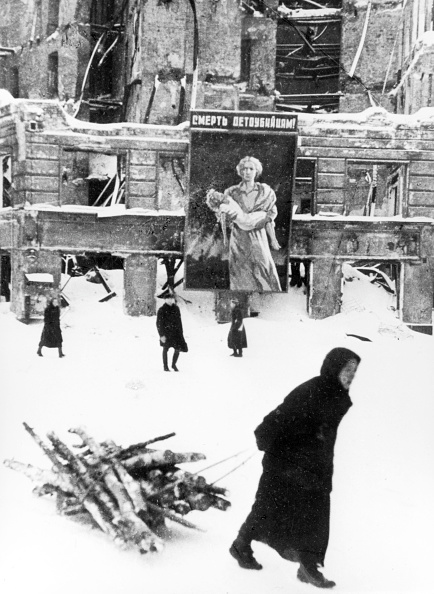
People began dying on the streets of Leningrad in early November 1941. Aleksei Yevdokimov, a twenty-three year-old diarist, wrote, “O, you, hunger, hunger, hunger! How on earth to survive you. Whoever will live will never forget these days and will always know the price of life. Almost the entire population is swollen from hunger. Horses, cats, and dogs are disappearing from the streets. The children especially are dying.” In December, the authorities began digging mass graves for the bodies of the starved.4
The Soviet secret police tracked talk among the population about the Allies opening up a second front to relieve the blockade. In October 1942, one factory worker complained, “Soon winter will come. It will be worse than the last one. Again people will begin to die from hunger. All hopes for opening a second front are lost. We have allies that equally hate Germany and the Soviet Union.” For the starving population of Leningrad, only the Soviet victory at Stalingrad, not an Allied offensive in Europe, began to turn the tide against Nazi Germany. Salvation would not come from abroad.5
“Now we all have one common goal—erasing the Gaza Strip from the face of the Earth”
Official statements about Gaza by Israeli authorities have mirrored central themes that the Nazis used to justify Operation Barbarossa. As human rights organizations such as Amnesty International have noted, this dehumanizing language conveys genocidal intent as well as incitement to further genocidal violence.
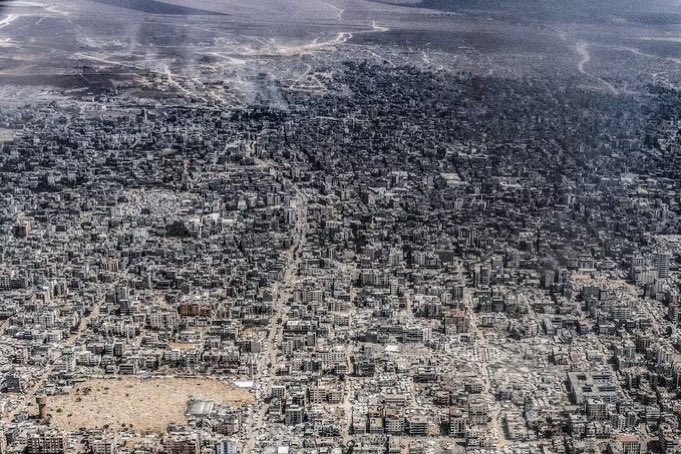
From at least 2007, Israeli leaders had referred to Gaza as an “enemy entity.” On the day of the October 7, 2023 attack, the deputy speaker of Israel’s parliament took to social media to announce, “Now we all have one common goal—erasing the Gaza Strip from the face of the Earth.”
Announcing “the complete siege” of Gaza on October 9, Defense Minister Gallant proclaimed, “There will be no electricity, no food, no water, no fuel, everything is closed.” Israeli politicians like Gallant characterized the war as a fight against “barbarism” and called Palestinians in Gaza “human animals.”
In late October, Netanyahu referred to Gaza as “the fortress of evil” and praised soldiers’ commitment “to eradicating this evil from the world, for our existence.” Calling Gazans “sons of darkness,” he also invoked a Biblical verse calling for the extermination of an ancient people, “Amalek,” who had been enemies of the Jews. Such language figured prominently in South Africa’s December 2023 case that accuses Israel of genocide at the International Court of Justice.
Apart from the legal classification of such language, it is important to note how Israeli language has repeated many of the German tropes of 1941. Israeli officials and their defenders in the US and Europe have repeatedly claimed their actions in Gaza are “self-defense.” They have taken the argument further to argue that this war is about the very “existence” of Israel.
As early as October 2023, Israeli authorities asserted that they were fighting for all of “humanity” and, in particular, as Israeli President Isaac Herzog put it, “to save Western civilization, to save the values of Western civilization.” Netanyahu attempted to align Israeli’s assault on Gaza with the defense of an ostensibly superior West and the prevention of a kind of domino effect when he said, “Our allies in the West and our partners in the Arab world, understand today that if Israel does not win, they will be next in line in the axis of evil’s campaign of conquest and murder.”
Like Israeli claims that they are fighting for “the West” in Gaza, this reference to an “axis of evil” and a broader geopolitical challenge justifying the starvation of Gaza recalls Hitler’s framing of the invasion of the USSR as a defensive measure to save the Reich—and “European civilization”—from British encirclement and Bolshevik expansionism.
This geopolitical approach to the genocide has its defenders who are content to see Palestinians as so many pawns on the chessboard of geopolitics. For instance, the historian Niall Ferguson, who, in denying that Israel is doing anything nefarious in Gaza, has insisted that critics of Israel seek its defeat (along with Ukraine). By this account, Israel’s “defeat” would not just “mean obliteration, extinction.” It would be a blow to the global power of the West: “For the US and the UK, and indeed for the EU, the destruction of Israel and Ukraine would be more than inconveniences. Such outcomes would significantly worsen the West’s strategic position and strengthen that of the axis of authoritarians: China, Russia, Iran and North Korea.”
While reinforcing the dangerous existentialist rhetoric shared by leaders of the Third Reich and contemporary Israelis, this line of interpretation ignores the fact that, like the Germans at Leningrad, Israeli leaders have long viewed the starvation of Gazans as a legitimate means to wage war.
In September 2024, for example, an influential Israeli security figure, Giora Eiland, circulated a proposal—called “The Generals’ plan” in Israeli media—to force Palestinians in the north of Gaza to make a choice: “surrender or starve.”
Another proposal, made in July 2025 and backed by Netanyahu, calls for the forcible relocation of some 600,000 Palestinians to a “humanitarian city” in Rafah, where they would await so-called “voluntary migration.” However, some military leaders have criticized the plan. One activist and reservist, Yotam Vilk, objected: “Relocating and concentrating an entire population is, by all legal and moral standards, a war crime.”
How Sieges End
The Germans were forced to lift the siege of Leningrad after their defeat at Stalingrad and advances by the Red Army. The fate of Gaza remains in the air.
The various Gaza projects floated by Israeli and American officials range from a plan of annexation and settlement of what Finance Minister Smotrich has recently called “an inseparable part of the land of Israel” to the development of a grotesque “Trump Riviera,” which Israeli businessmen, American consultants, and Tony Blair’s think tank have already begun planning.
The mass starvation of Palestinians is crucial to whatever comes next. Its purpose is to advance Israeli plans to summarily destroy the Palestinian presence in Gaza.
There is almost nothing standing in the way. Israeli society could prevent it, but public opinion polls suggest otherwise. Official rhetoric portraying all inhabitants of Gaza as collectively responsible for the October 7 attacks has clearly had an impact.
A May 2025 poll by scholars at the Hebrew University of Jerusalem is an index of the impact of such dehumanizing language: 64% of the Israeli public agreed with the assertion that “there are no innocent people in Gaza.” A separate poll in May concluded that some 82% of Jewish Israelis support forcibly expelling Palestinians from Gaza, and more than half backed their expulsion from Israel itself. Parts of Israeli society have mobilized in support of the siege. Civilian groups such as Tzav 9 have organized protests to physically block trucks from delivering aid; and the Israeli police have rarely intervened to stop them (though the Biden administration imposed sanctions on Tzav 9 in 2024).
Israel’s most powerful backer, the US, is in a much stronger position to bring the siege and famine to an end. Forcing an end to the war could win the support of the majority of Americans. US public opinion has begun to move against Israel’s handling of the war: according to a Gallup Poll of July 2025, some 60% of Americans “disapprove of the military action Israel has taken in Gaza.” An April Pew Research Center poll found that 53% of Americans now “express an unfavorable opinion of Israel.” It is doubtful, however, that these shifts will translate into policy changes when the White House and Congress are still firmly on the side of whatever actions Israel takes—and oblivious to their complicity in genocide and the destruction of what remains of international law.
Military defeat, resembling the fate of Nazi Germany, is another potential outcome, but the least likely to occur given current conditions. Failing a massive and immediate international intervention, more Palestinians will needlessly die excruciating deaths—and with them will perish any notion, outside of the West itself, of Western superiority and its commitment to human rights and the sanctity of human life. Letting Israel starve Palestinians will leave an indelible stain on all who could have prevented it, and Gaza will be remembered alongside Leningrad as case studies of the extremes of human cruelty and suffering.
Robert D. Crews is professor of history at Stanford University.
footnotes
- 1 Gerd R. Ueberschär and Wolfram Wette, eds., Der deutsche Überfall auf die Sowjetunion: »Unternehmen Barbarossa« 1941, 2nd ed. (Frankfurt am Main: Fischer Taschenbuch Verlag, 2011), 265-269 and 287-289.
- 2 Ibid., 251 and 287-289.
- 3 Ibid., 280-281.
- 4 Richard Bidlack and Nikita Lomagin, eds. The Leningrad Blockade, 1941-1944: A New Documentary History from the Soviet Archives (New Haven, CT: Yale University Press, 2012), 267.
- 5 Ibid., 364.