I Am Somebody
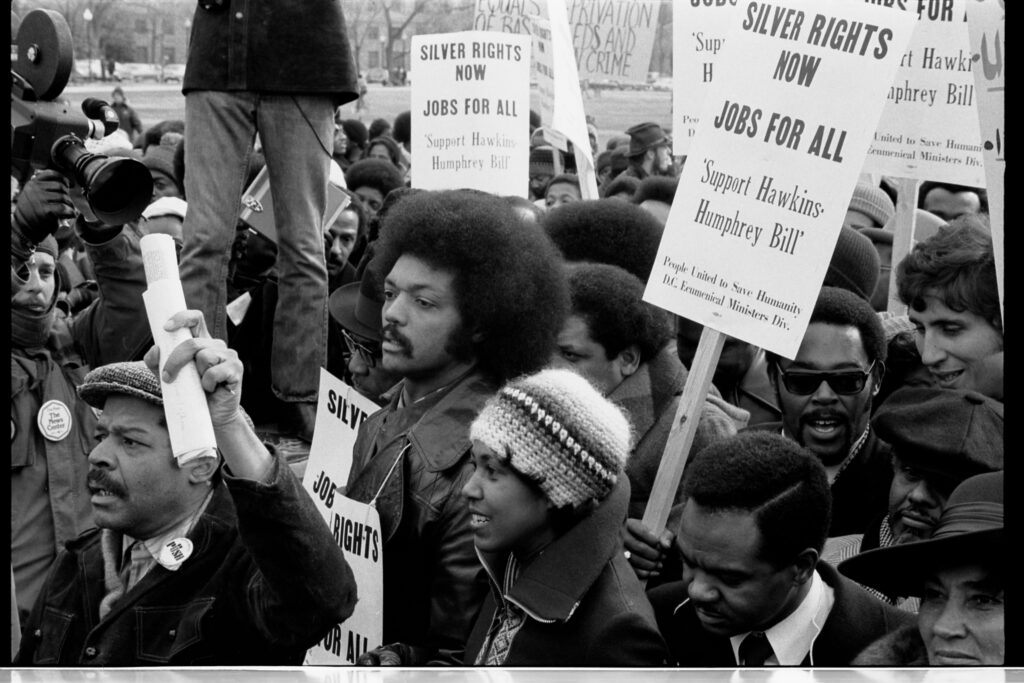
“I have fought the good fight, I finished the race, I have kept the faith.”
2 Timothy: 4:7-8
In 1970, Jesse Jackson recited the poem “I Am Somebody”—words that he wrote to inspire a race of people that two years earlier lost their “King,” Rev. Martin Luther King Jr. It served as a clarion call for the black community and poor Americans everywhere during a time of repression targeting the newly passed Civil and Voting Rights Acts.
I was not yet alive when Jackson delivered this poem the first time, nor when he recited it on Sesame Street in 1972. Yet every February at my home church, during our annual Black History Month Program, someone would read these words with passion:
I Am Somebody—I am—Somebody! I am—Somebody! I may be poor, but I am—Somebody! I may be young, but I am—Somebody! I may be on welfare, but I am—Somebody! I may be small, but I am—Somebody! I may have made mistakes, but I am—Somebody! My clothes are different, My face is different, My hair is different, But I am—Somebody! I am black, brown, or white. I speak a different language, But I must be respected, Protected, never rejected. I am God’s child!
As a young black boy growing up on the red clay roads of Southwest Georgia, hearing the reading of these words in a small Baptist church filled me with pride, pride that I did not even recognize that I needed, pride in myself regardless of my position in life. I was Somebody, in spite of what the world thought of me or my lot in life. Yes, Rev. Jackson inspired me and many like me to believe in myself when others refused to see us!
The life and legacy of the Rev. Jessie L. Jackson is complicated, yet inspirational. From his first light of day in 1941, Jessie entered this world in the Jim Crow South. He was born in the heart of the Confederacy, Greenville, South Carolina to Helen Burns and Noah Louis Robinson, a World War II veteran. One year after his birth, his mother Helen married Charles Henry Jackson, from whom his surname is derived. (He would credit both men with his growth and development.) It was this upbringing that provides the prologue to Jackson’s life—a life of advocacy for the least of these, a life marked by controversy and a political career that laid the foundation, nearly twenty years after his 1984 presidential run, for the election of Barack Obama.
There were many seasons in Jackson’s nearly eighty-five-year existence. However, the ones that I am most aware of were the last two quarters of his life: from the 1980s through his earthly transition. For sure, some eulogists, biographers, and essayists will remember Jackson as a football player and Student Government President at North Carolina A&T State University, or as the young Lieutenant of Rev. Dr. Martin Luther King, Jr. Others will recall his work as the leader of Operation Breadbasket in Chicago—or the iconic photograph that captured him among the few men standing on the balcony in front of room 306 of the Lorraine Motel as an assassin’s bullet robbed the world of the prophetic leadership of Dr. King.
I read about that Jackson. I learned about that Jackson. But this country boy from Whigham, Georgia was inspired by the Jackson of the 1980s, 1990s and early 2000s. One of Jackson’s most pivotal moments came in 1984. For some, Jackson’s presidential candidacy was a foreshadowing of what might be possible for black people in the American political process.
Just sixteen years after Dr. King was assassinated, Rev. Jackson became just the second African-American to make a serious run for the presidency of the United States of America. Twelve years after Shirley Chisholm’s 1972 run, the first by an African-American and the first by a woman to make a serious challenge for the presidency, in 1984 Jackson utilized many of the grassroots tactics that Chisholm had deployed in challenging President Ronald Reagan.
Although initially dismissed (like Chisholm before him) by the Democratic Party bosses, Jackson surprised the party—and the nation—by earning 3.2 million primary votes. He came in third behind Senator Gary Hart and former Vice President Walter Mondale. In all, Jackson won five primaries and caucuses during this historic run, including Virginia, Louisiana, South Carolina, the District of Columbia, and one of two separate contests in Mississippi. With such an impressive campaign, Jackson earned a primetime slot during the Democratic National Convention in July in San Francisco.
In that moment, Jackson delivered an address that, yes, spoke to his era in which the Reagan Machine systematically attacked and eroded the social safety net that was woven together by Jackson and his mentors during the Modern Civil Rights Movement decades earlier. His speech clairvoyantly addresses us today, regardless of one’s political leanings. Jackson’s 1984 DNC address provides hope—hope that we, the collective, have the ability to fight back against the “isims:” racism, sexism, and classism.
Though over forty-years old, this message is as relevant today as it was in 1984. Jackson spoke to the idea that everyday Americans were looking for people to stand up for them, for their rights, to see them, support them and to basically care about their needs and to appreciate the role they played in this nation. My family was proud of Rev. Jackson—and not just because he was a black man, a HBCU alum, and a country boy. We were proud because when he had the opportunity to speak, he didn’t speak for himself. We believed that he spoke for us.
I felt a similar sentiment twenty years later. As a first-year graduate student in the PhD program at the University of Memphis, I heard echoes of Rev. Jackson’s ’84 DNC speech when another young African-American organizer from Chicago took the stage at the DNC in 2004. Back in 1984, Rev. Jackson closed his address in a sermonic tone by proclaiming that “America is not like a blanket, one piece of unbroken cloth—the same color, the same texture, the same size—America is more like a quilt, many patches, many pieces, many colors, many sizes, all woven and held together by a common thread—the white, the Hispanic, the black, Arab, the Jew, the woman, Native American, the small farmer, the business person, the environmentalist, the peace activists, the young, the old, the lesbian, the gay and the disabled make up the American quilt.”
As I sat in my one-bedroom apartment in Bartlett, Tennessee, I—like my parents twenty four years earlier—was mesmerized by a young, tall, skinny black man, speaking passionately about hope and change, and about how America was not made up of Red States and Blue States, but the United States. It brought me back to the early- and mid-1980s, when Jessie Jackson captivated my community with a similar message of national unity and hope, hope that we would push this nation to live up to the dreams of our ancestors—dreams that they embedded in us, dreams that many of them died fighting for, dreams that are etched on parchment paper, that all men are created equal, that they are endowed by their Creator with certain unalienable rights, that among these are Life, Liberty and the pursuit of Happiness.
Four years later, I sat glued to my television screen as Barack Obama and his family emerged on a stage in Grant Park to deliver his victory address as the first African American President of the United States. I now understand the tears of my mother, and elders. But more clearly, I understand the tears of Rev. Jessie Jackson, standing among the sea of witnesses to celebrate a victory that he and his fellow foot soldiers fought so hard to see: the day that many hoped would mark the beginning of black folk, poor folk, and the overall marginalized to be fully included in the American experiment.
While the Obama Presidency provided a great sense of pride and hope for a generation of Americans, the US is facing forms of repression resembling those Rev. Jackson combatted. In the face of these current attacks on our social safety net, we must remember the charge of Rev. Jackson: to Keep Hope Alive. I believe Rev. Jackson would comfort us and charge us today with the words of Apostle Paul, “I have fought a good fight, I have finished the race, I have kept the faith.” Now it’s our time to pick up the torch and ensure that the dream of this American experiment becomes a reality.
Reginald K. Ellis, PhD is Dean of Graduate Education at Clark Atlanta University.