Iran and America’s Long War in the Middle East
Washington has been stoking conflict with Tehran for decades. Driven partly by Israeli ambition, the conflict has now turned into a regional war, and there is no endgame. Its permanence is the plan.
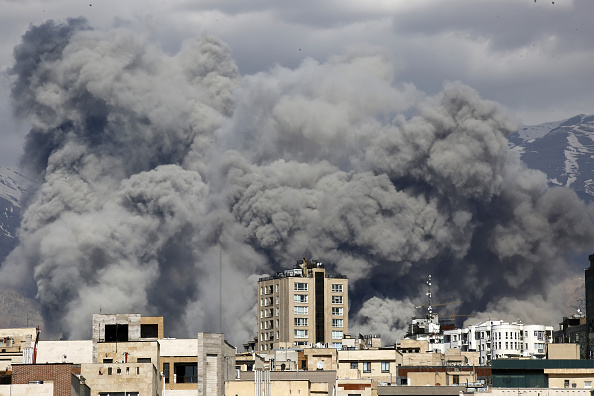
In remarks made in an early morning press conference on March 2, Pete Hegseth, the figurehead of America’s revitalized, though fragile, macho-militarism, offered up the rationale for the Trump regime’s war with Israel on Iran. Almost breathlessly, and just days after an Israeli strike killed Iran’s Supreme Leader Ali Khamenei, Hegseth celebrated that the war “had become our retribution against their Ayatollah and his death cult.” Trump “reminded the world…being an American means something unbreakable. If you kill Americans. If you threaten Americans anywhere on Earth, we will hunt you down without apology and without hesitation and we will kill you.”
For an American president and ruling class hung up on monuments to their power and to symbols of their authority, Hegseth touted that that it “took the 47th president…to finally draw the line after 47 years of Iranian belligerence.”
Preaching to a shrinking choir, his remarks sought to whip up support and perhaps to quell the possibility of resistance, by peddling familiar kinds of hysterical Islamophobia, distorting Iranian nuclear capacity, and suggesting that a country long besieged by American empire and devastated by US sanctions was a threat because it had taken measures to defend itself by building up its own “conventional” capacity. He claimed Iran had a “conventional gun to our head as they tried to lie their way to a nuclear bomb.”
In what must be seen as an effort to disassociate from the neoconservatives and their Iraqi quagmires, Hegseth beat his chest while simultaneously suggesting that the Trump regime is not a warmongering syndicate, observing wryly that “this is not a so-called regime change war. But the regime sure did change.”
Hegseth’s press conference performed the dutiful role of attempting to make war legible by invoking long established logics of security, crisis, and fear–the terms by which American power in the world has been framed since the Cold War. His remarks channeled echoes of old claims about roque states in the Middle East, regional madmen, skulking Muslim terrorists, Israeli security, and a bundle of old imperial dangers that have maintained a grip on the political class since the late 20th century.
It was a performance meant to fill what had until then had been a messaging vacuum from the White House. While Hegseth hid behind security claims, it is likely clear to even casual observers that there are other powerful factors driving Trump’s war. It is most obviously connected to Israel’s genocide in Gaza and the Israeli project to carry on ethnically cleansing Palestinians. Trump, along with no shortage of his otherwise political opponents, has happily bought into Israeli Prime Minister Netanyahu’s fanning of regional war to sustain anti-Palestinian violence.
Direct American entanglement with Israel’s violent ambitions was clear already in June 2025, when Trump ordered US strikes on Iran’s nuclear facilities in support of Israeli demands to ramp up regional confrontation. And, of course, the war is unfolding against the backdrop of Trump’s intimate relationship with Jeffrey Epstein, his apparent complicity in trafficking and sexually assaulting girls, and his closest aids dogged commitment to obscuring the truth and shielding him from justice. More absurdly, Trump even recently suggested that there was a connection between the war and what he claimed was Iranian interference in the 2020 and 2024 elections.
Hegseth’s invocation of deeply rooted anti-Islamic sentiment and the specter of both old and new Iranian perfidy belied what was an impoverished bit of performance. It is, to be sure, partly a reflection of Trump’s singular approach to his power, the lack of any accountability for him, and his regime’s brazen embrace of strong-man brutishness. There is little evidence for claims of immediate danger or of Iranian blackmailing its way to a nuclear weapon—or that it posed any kind of threat. A handful of critical observers in Congress agree that no evidence has been provided supporting these claims.
The truth hardly matters, though. The decision to wield American might without compelling strategic reasoning is resonant with the American coup in Venezuela in January and the ongoing siege on Cuba.
These are wanton displays of aspirational power. They continue in part because there is hardly an opposition. Now that the hollowness of the American political project has been fully laid bare, Trump’s bellicose theater no longer has to make sense.
Some progressive democrats in Congress have vocally rejected the war, and others have mobilized to invoke congressional power to limit the campaign. But there is no consensus among liberals that war against Iran is undesirable.
In fact, much of the debate within the “opposition party” seems to be about the terms of a military campaign, rather than mobilizing against it. There is no difference in New Jersey’s pro-genocide Democrat Representative Josh Gottheimer’s hawkish view of the war and the Trump administration’s, for example. Others are similarly in lockstep. Outside of power, the American anti-war movement has failed to mobilize since before the invasion of Iraq in 2003. In any meaningful way, an American anti-war movement does not exist.
The lack of a compelling rationale for the war as well as for any accountability are rooted in Trump’s peculiar and particularly brazen disregard for law and the “rules-based order” at home or in the world; they are simultaneously feckless and predictable.
For all of the performative inanity, Hegseth’s remarks unintentionally offered an opening for making sense of both the war and, if not broad support for it, then at least the absence of energetic opposition to it. He opened his comments with the feint that “we didn’t start this war” mostly as a maneuver to carve out space to later extoll Trump’s braveness for doing what his predecessors had not—taking decisive steps to confront Iran militarily. The implication, of course, was that the US had remained indecisive against Iran since its revolution in 1979, the moment that it came to be seen as the primary danger to America in the Middle East along with its allies there.
The reality is, as Hegseth accurately made clear, US policy and its militarization of the region—and no small part of its military history in the Gulf—has remained consistent for almost half a century. For all of its incoherence, the Trump administration’s war is not especially exceptional, even if the United States had not previously participated in the assassination of an Iranian head of state.
Israel’s role in shaping the current moment is tangible and important. Yet the American commitment to war in the region operates according to its own logic. It is necessary to reckon with exactly how and why this joint campaign with Israel, although it benefits Netanyahu, is an American war.
The US waged a long war on Iraq from 1991 until 2012. However, it is little appreciated that American forces, including the second largest naval convoy since World War II, spent the second half of the 1980s engaged in a naval war with Iran. During the tail end of the Iran-Iraq war (1980-1988), American forces routinely engaged with Iranians at sea and in the air, including shooting down an Iranian passenger jet in July 1988 that killed 290 civilians.
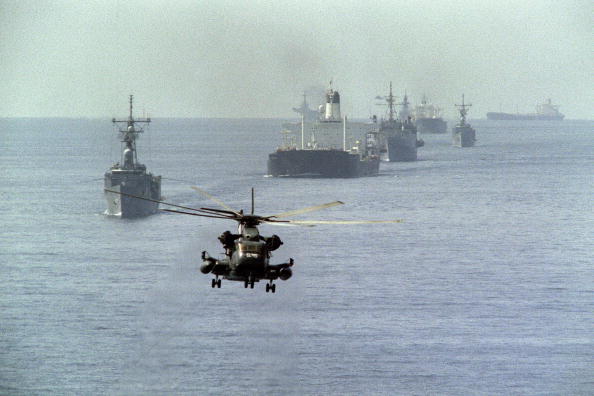
The United States has maintained oppressive sanctions on Iran and built out a sprawling empire of bases in the region ever since. Trillions of dollars have been directed to confronting Iran, deterring Iran, and to maintaining a more or less permanent war footing against it. None of this is new.
The logic for securing the Persian Gulf in this way was originally founded on President Jimmy Carter’s response to the Iranian Revolution and the Soviet invasion of Afghanistan in 1979. It has remained a pillar of America’s place in the region and its security doctrine ever since. From containment to confrontation, every president since—and from both parties—has viewed Iran as a belligerent power. Several have acted on this view.
Hegseth acknowledged the arc of history, though he inaccurately claimed there had been no previous American commitment to doing something similar. The historical record makes clear that the opposite is true: war and the creation of the permanent conditions for war against Iran have been a central element of US power since the 1980s. In 2026, what distinguishes Trump’s war from its earlier phases is the almost total absence of a clear, immediate objective.
Arguably, the normalization of war and the war footing against Iran have become so entrenched, that they are part of American political DNA in 2026. From Senator John McCain’s cavalier call to bomb Iran during his 2008 presidential campaign to the stoking of fears of an emerging Shia crescent led by Iran to justify operations during the Iraq War, the specter of war with Iran is baked into how America operates in the Middle East. It is also central to the way that the Middle East generates political possibility in the United States.
It was never a matter of if, but when, American missiles would target Iran. Trump’s crass approach to the world and the ways he measures his worth by his understanding of how he wields American power renders his role unsurprising. The conditions of this possibility were built long ago.
American wars in the Middle East, including its role in the genocide in Gaza and the campaigns against Lebanon, are also not just projections of power or solely a reflection of long-standing strategic interests that merge with cultural zeitgeist. They are also generative and reproductive of American political power and capital.
War and capital are productive of one another everywhere. It is useful to reflect on American wars in the Middle East and the current Iran war as extension of this. Profiteering from war in the Gulf is connected to the project of American political renewal, to the very ways that American leaders see war as productive of their personal power and the social networks from which, and through which, their power is created.
As Charles Tilly noted almost 50 years ago, state-making and war-making in the West have long been part of protection rackets, and, he provocatively suggested, are analogs to organized crime. Tilly’s argument is that Western states have a history of building political power and capital through war, seizing upon their power to wield violence “legitimately” in order to forge social connections, generate value, and, just as importantly, as part of an ongoing process of coming into being and renewal.
Although he was focused on Europe in the early modern period, Tilly’s lessons are productive to think with. He notes that “War makes states…Banditry, piracy, gangland rivalry, policing, and war making all belong on the same continuum.” While he limits his view historically, his observation that “mercantile capitalism and state making reinforced each other” offers a provocative lens on the ways that American war in the Middle East has never just been about security. It has also been about generating value and regenerating political power.
Trump’s criminal history and apparent ongoing criminal entanglements make this comparison enticing. But here, too, war and capital are blended historically. The Gulf and Iran are central pillars of a 50-year-long project. Along with score settling, Trump likely views the war as generative of his personal power and more.
Beyond whatever ways Trump personally profits from the current moment, war and the Middle East are also generative in far more meaningful and widespread ways. Oil is critical to keep in sight, though it is only part of the order of things. While advocates and architects of the pursuit of “energy security” have put oil at the center of the story since the 1970s, calling for ensuring its flow and guaranteeing American access, it is also useful to understand oil’s value in relation to all the other kinds of value it has helped generate.
Protecting oil after the 1970s generated the massive proliferation of American weapons sales and military development to the Middle East ever since. Billions of dollars of American-made weapons have been sold to Arab allies and to Israel. Trillions of dollars have been appropriated to build these systems on American soil. From the early 1980s, the political economy of weapons linked America’s relationship with Israel to its Arab allies and against Iran. It is an all-encompassing political economic project that links American strategic concerns in the Middle East to its material interests.
Since Ronald Reagan, the United States has maintained a commitment to the military as an engine of the American economy. Military industry—the jobs it created, the spaces and geographies it transformed from Maine to Mississippi and New Jersey to Washington—made war, and especially war in the Middle East, central to the making of opportunities for work and the production of capital in the United States. While its overall share of the American economy is not that of the late Cold War, it remains a vital part of national spending.
When approached this way, what congressional representative, regardless of party, will argue for an end to war that might dismantle the industries that make social stability and voter support possible in their districts? War in the Middle East is not just profitable. War and the geographies of capital it makes possible are also built into local politics across the United States.
This is all to say that permanent war, whether waged or threatened, and the crises that made it necessary were not just strategic projects, but were also central to American capitalism. Crisis in the Middle East itself has been fully embraced by the United States, Israel, Saudi Arabia and other allies in the region because it benefits them materially, alongside those Americans and war merchants that have become synonymous with the racket of “protecting” them. The effectiveness of this gambit is presently in question: the Iranian response has so far demonstrated that the American protection racket may not be fully up to the task.
War against Iran has a complicated and opaque history. There is a suddenness to the current moment and to its absurd elements. While Hegseth mocked and celebrated the death of Iran’s leader, it is far from clear what has actually changed in Iran.
It is a stretch to think Iranians will rise up again in revolutionary ferment and toss aside decades of acrimony in support of the United States or Israel, whatever the hawkish elements of the Iranian diaspora would have us believe. More, there is not much happening to suggest the war will end well, or that it will end clearly at all.
In reality, the point for Trump and for American empire is not to have an exit strategy. From his personal weakness to the imperial war-industrial-complex connected to the Middle East, too much depends on the absence of an end.
As was the case with the murder of almost 300 innocent people aboard Iran Flight 655 in 1988, those who will pay the real price now include the more than 150 schoolgirls and staff in southern Iran that were killed by a missile strike against their school on the first day of this war. Even here, Trump’s terrible criminal assault on the innocent, including children, is hardly new.
Toby Craig Jones is associate professor of history at Rutgers University, New Brunswick. He is the author of Desert Kingdom: How Oil and Water Forged Modern Saudi Arabia (Harvard University Press, 2010), Running Dry: Essays on Energy, Water and Environmental Crisis (Rutgers University Press, 2015), and is currently working on a book on the shooting down of Iran Flight 655 and American Empire in the Middle East for Verso.