Neither Culture Wars nor Big Tents Will Save American Democracy
Centrists like Ezra Klein call for a kinder, more connected liberal culture. But without building public systems that allow people to actually care for one another, civility is just polite sentiment to cover over the fact of cruelty.
Ezra Klein’s new manifesto for unprincipled centrism in The New York Times is right about something essential: the only way to beat Trumpism is by rebuilding the bonds of common life. Politics, as political theorist Bernard Crick wrote and Klein reminds us, requires relationships with “genuinely other people.” But Klein mistakes culture for cause. By doing so, he obscures how we have arrived at Trump’s second term, and what beating Trumpism will require.
Klein wants liberal cultural virtues–mutual regard, generosity, a widened circle of belonging–without investing in the public systems and human infrastructures that make such virtues possible and durable. Community isn’t a sentiment; it’s a deliberately built social environment. It needs institutions–public health and social care, housing, childcare, schools, debt relief, neighborhood jobs–that give people time, stability, and proximity to be able to care for one another.
Absent that concrete foundation, calls for “community” and “cultural change” drift into sermons. And sermons are cold comfort in a society that, after decades of bipartisan privatization and deregulation schemes, is organized around precarity and the profits that can be made from it.
“Changing a culture is harder than changing a policy,” Klein writes, repeating a long-standing use of “the culture concept”–developed by anthropologists over the last century–to deflect attention from underlying political responsibility, elite interests, and inequalities of power. He treats culture as an abstract, autonomous sphere of moral attitudes – something to be reformed through discourse and personal example–rather than, as countless anthropologists have demonstrated, a lived system of meanings generated and sustained by material arrangements and daily practices.
Culture and interpersonal relationships don’t hover above policy and political economy; they condense and reflect it. When market-fundamentalist policy allows public infrastructures that organize everyday life to fall apart, when work, housing, and care become unreliable, so too do the habits of trust and mutual regard upon which liberalism depends.
Klein’s strategic advice – that Democrats should be capacious enough to represent more places and tolerate more internal differences – is fine as far as it goes. But representation is not primarily a matter of rhetorical posture; it is the downstream effect of policy architectures that bind people’s fates together. The fracture he deplores is the predictable result of longstanding neoliberal governance and managerial technocracy, now rebranded by Klein as “the abundance agenda,” that hollowed out the public institutions that once gave pluralism a floor. You can neither preach nor manage your way to trust when daily life is mediated by billionaire-owned algorithms and private-equity-owned hospitals as millions of people are going hungry and teetering on homelessness.
This is where Klein’s culture-first liberalism becomes weightless. It treats polarization as a problem of tone and temperament rather than a phenomenon arising out of the political economy of everyday experience. The premise is that if Democrats radiate respect, persuasion will follow.
But persuasion is hard when people meet one another chiefly as competitors in labor, education, housing, and health markets, or as avatars in a national media ecosystem controlled by far-right oligarchs. The crisis of representation is a material problem before it is a messaging problem.
The Politics of Care
What’s missing from Klein’s account is the most elementary material problem behind our cultural and political decline: the collapse of care. Philosophers from Socrates to Michel Foucault and Joan Tronto have long understood care not just as a clinical task, but as an ethical and political practice.
In this tradition, care is understood as both the provision of material support to others and the cultivation of an inner experience of concern towards those for whom one cares. It serves as an antidote to nihilism, apathy, and the tendency towards massification and violence as responses to alienation. Caregiving is, in short, a practice of disalienation–that is, of recuperating our sense of ourselves as unique individuals in community with one another rather than simply cogs in a machine.
In our era of profound inequality and distrust in which meaning and interpersonal ties are more tenuous than ever, reviving this broader vision of care is essential for improving failing American health systems. It may also be the only way to revive the possibility of democracy itself.
Although few dispute the importance of care, its role as a matter of the soul–both of the individual and the nation–has been marginalized. Under American health capitalism, care based in interpersonal relationships and as an embodied, ethical experience for both caregiver and care receiver has been dismantled and devalued in favor of profit-generating medical treatments, along with their depersonalizing emphasis on technology, hierarchy, and layers of bureaucracy. This has systematically evacuated care of its soul.
Today, most experiences of health care are not only not disalienating but, when medical bills are the leading cause of personal bankruptcy, are often a direct cause of alienation. This isn’t just a problem for patients and medical professionals plagued by demoralization; it has long been a fundamental problem for American democracy. As the historian of authoritarianism Timothy Snyder has put it, our failing care systems constitute “an invitation to tyranny”–one that played a key part in ushering Donald Trump back to the White House.
Klein’s appeal to “liberality” bumps into this reality. Generosity and tolerance are not free-floating virtues. They emerge from political-economic conditions that make them actionable: robust public goods, shared institutions where people collaborate, and regular opportunities to both receive and give care. If you want citizens to encounter those who are “genuinely other people,” you must build the places, systems, and jobs where that happens with dignity and genuine support attached.
There are policy agendas to achieve that–and to advance a politics that’s truly reconstructive rather than nostalgic or simply about resisting Trump. They begin by acknowledging that Americans are right to be furious with status-quo systems that have failed them, and then channel that anger toward building something far better and tangibly transformative.
In health policy, that means universal coverage–Medicare for All–but also far more than medical care: a public infrastructure for community care that recruits, trains, and stably employs at least hundreds of thousands of lay community care workers in communities where unmet needs are greatest.
These should be well-paid, unionized public jobs–compensated and valued as career positions like the jobs currently given to law enforcement officers and military personnel–not grant-dependent positions chained to medical reimbursement codes. Such jobs would provide preventive social support, accompany neighbors through crises, and knit medical, mental health, housing, and benefits systems together so that help arrives before catastrophe. There is abundant evidence from around the world that such programs dramatically improve health and reduce medical costs. Even more importantly, public care jobs of this kind weave the social fabric on which democratic life depends.
This is not about charity from the credentialed to the “underserved.” It is about reciprocity and participation, that is, caring alongside one another, not care for the other. When daily caregiving becomes a public job and shared civic project, people cease to be objects of policy and become active participants in it and co-authors of it. The democratic dividend is trust built at doorsteps and in living rooms, not just at rallies. It is precisely this infrastructure of care that decades of bipartisan free-market dogma, bolstered by the health-industry lobby, neglected or dismantled. And it is what must be rebuilt if any pluralist politics worth the name is to stand.
An Ethic of Shared Purpose
Reviving democracy will require more than building systems; it also requires engaging desire. The prevailing liberal response to Trump has been managerial: displays of competence, fact-checking, appeals to moderation and civility, and, when all else fails, moral opprobrium. That approach ignores a basic truth about politics in our media-saturated age: effective politics cannot not merely reflect existing preferences; it must shape the electorate’s desires.
Trump and the far right clearly know this and have been acting on it. They offer myriad affective satisfactions: primal identification with transgression, the thrill of grievance and dominance, violence against imagined enemies. But the libidinal energy that fuels this destructive current in Trumpism is fungible, and it can be redirected. It will not, however, be redirected by civility lectures or administrative competence alone. To channel it into democratic possibility will require bold, inclusive public projects and narratives that give people belonging and something to feel and build.
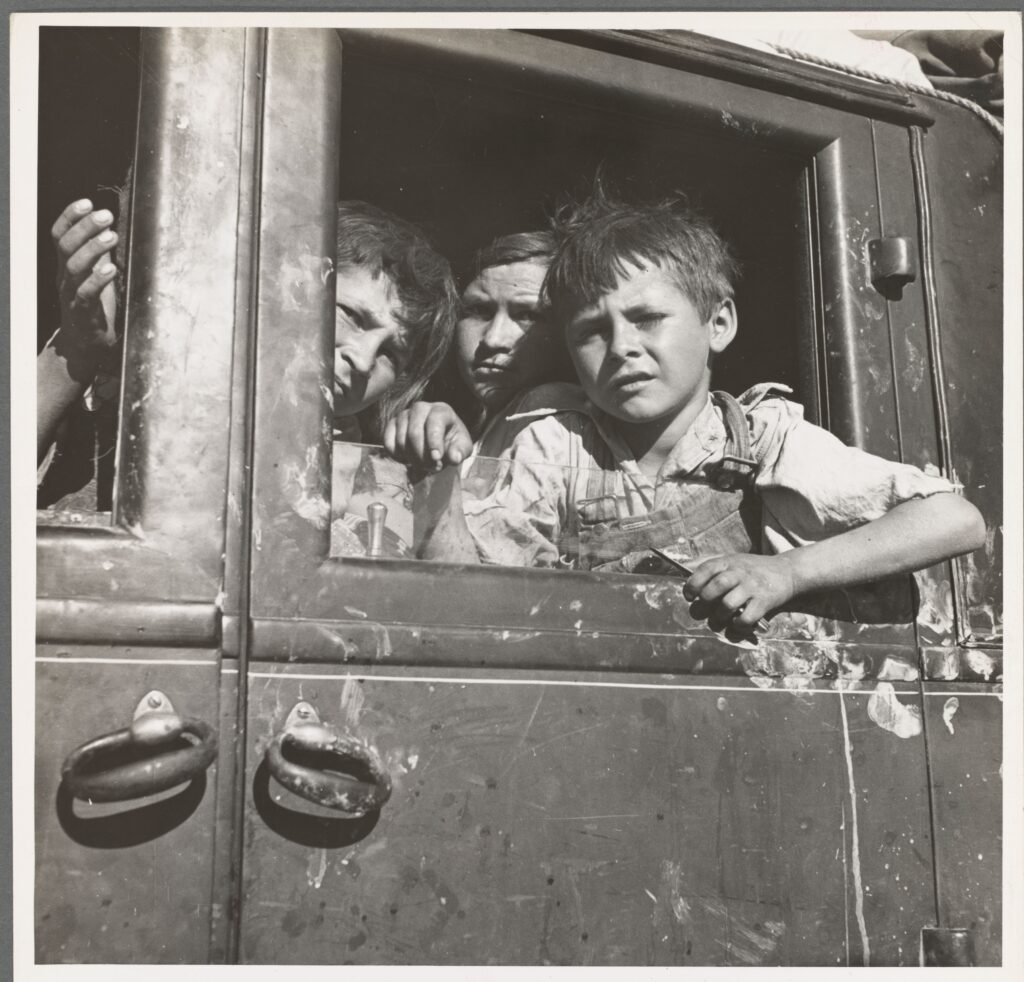
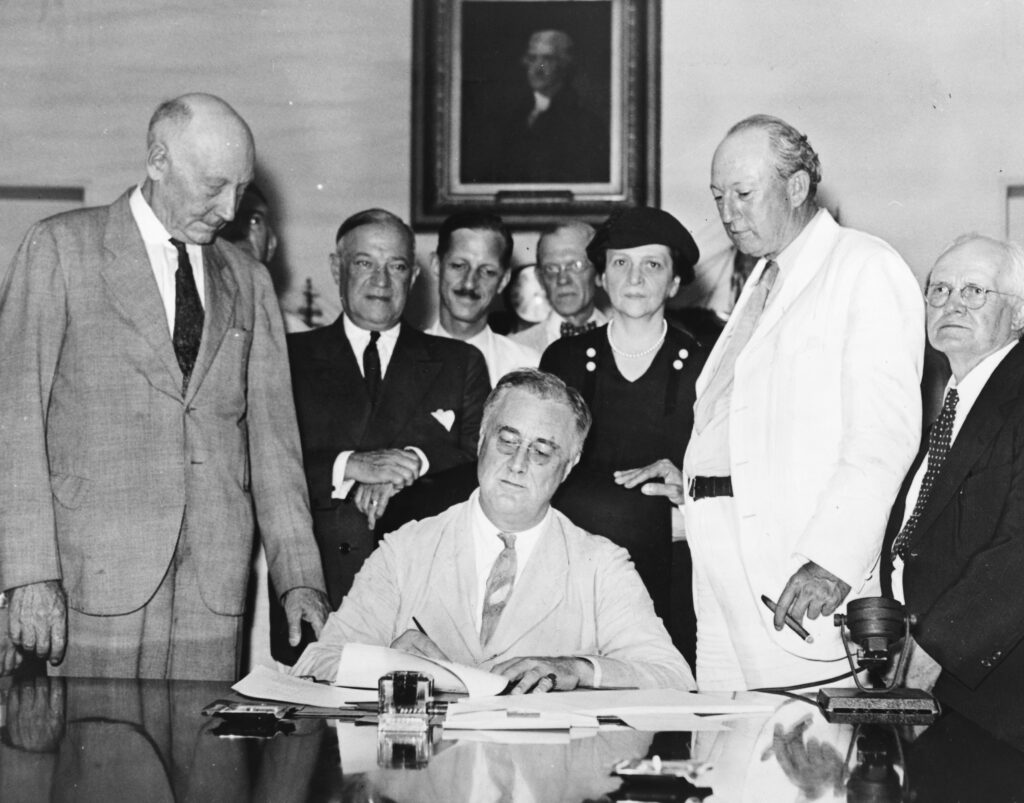
Progressive Democrats have done this before. Faced with mass disaffection during the Great Depression, the New Deal didn’t simply promise technocratic fixes. It mobilized millions in collective work, providing them with public jobs to build tangible infrastructure coupled with an intangible–and invaluable–ethic of shared purpose. The genius of that era wasn’t only economic; it was aesthetic and affective. It transformed diffuse anger, fear, and desperation into shared construction rather than divisive destruction.
This is the lesson Democrats keep refusing to learn. If their political offering continues to be little more than a return to the pre-Trump “normal” that produced him, they will lose the war of desire to those who promise drama, power, and belonging–even if what they deliver in reality is nothing but xenophobic cruelty and gold-plated toilets and ballrooms.
To beat Trump, Democrats need to provide an opposing grandeur worthy of both belief and mass participation: a wealth tax on the ultra-rich, universal childcare, student and medical debt forgiveness, guaranteed housing, a national community care worker system, and a Green New Deal scaled to the climate crisis. These are not simply policy checklists; they are vehicles for reshaping desire toward solidarity and shared creation. They are, in other words, the kinds of policies required to change culture.
The Labor Ahead
The psychoanalyst D.W. Winnicott’s short essay on “fear of breakdown” helps explain why elite liberals like Klein continue to fail to see the roots of both Trump’s appeal and of the Democratic Party’s ongoing failures to effectively counter it. They continue to insist that unity and loyalty–not reckoning nor bold policy agendas–is what the hour demands. Don’t criticize the powerful Democrats and policies that brought us here, they say; we’re on the edge of the breakdown of democracy, and we should do all we can to keep ourselves from teetering over the edge. But as Winnicott observed, fear of breakdown is rarely a fear of a future catastrophe; it is instead the displaced anxiety of a breakdown already suffered but unacknowledged.
Much of respectable liberal politics still behaves as if we stand at the brink of democracy’s dissolution and need only retrieve a lost measure of civility to step back. What the liberal elites refuse to see is that the collapse–of civic trust, institutional legitimacy, and ethical coherence–has in fact already occurred, and it did so on their watch. Denying it doesn’t stave off fascism; it disables us from organizing against it.
Seeing that the breakdown of democracy lies in the past, not the future, also allows us to see Trump more clearly. He is not the cause of democratic ruin but its symptom. His brazenness, corruption, and violent impunity is a consummation of the system that Democratic leaders built, not a true aberration from it. For decades, from Clinton to Obama and Biden, the conversion of public office into private profit was dignified as “public-private partnership.” Trump has continued this tradition but stripped away the polish and turned backroom corruption into open, shameless spectacle. You cannot out-perform that show with moralistic appeals. You have to make a different world feel possible–and then make it real enough that people can touch it, get paid by it, and provide care through it.
Klein wants a bigger Democratic tent. So do I. But a capacious culture of representation cannot substitute for a platform of material reconstruction and desire-shaping shared purpose. Voters who feel despised by elites are often those stripped of the institutions that would give them dignity independent of elite approval: unions, public jobs, neighborhood clinics, libraries, parks, and stable housing. When those institutions decay, politics degenerates into vibes. And vibes lose to violent spectacle.
The way forward is not to retreat from Klein’s call for connectedness, but to ground it. If politics is the art of negotiating differences–and, ideally, supporting and multiplying them–under a common rule, then the work before us is to renovate the “common”: the infrastructures through which we meet, rely on, and matter to one another. This political labor prioritizes building over branding, reciprocity over performance, and the ethical experience of reciprocally caring for one another over the satisfactions of solipsistic online expression, newspaper columns, or podcasts.
To beat Trumpism, we must name the breakdown of democracy that has already transpired over decades of neoliberal disinvestment from the commons and from care it supports. And for those in positions of power who oversaw the breakdown and whose careers and bank accounts benefited from it, they should take responsibility for the reality they’ve wrought.
Then let us treat politics not as civility training but as the work of caring for democracy: the deliberate construction of public, participatory systems of care that give our talk of community actual substance. That means Medicare for All–and a national community care worker system that keeps people from needing doctors and hospitals in the first place. It means universal childcare–and the well-paid neighborhood jobs and safe spaces to enable it. It means housing as a fundamental right–and the support teams that get and keep people stably housed.
It means regarding racial, gender, and religious differences not as inconveniences to be tolerated but as the very lifeblood of democracy and the wellspring of its essential creativity. It means moving resources from punishment to care and proving, block by block, that safety is a function of belonging and caregiving, not of policing or surveillance.
Klein is right that we must rediscover a politics organized around genuine relationships. But genuine relationships are built by fighting to protect one another’s safety and the freedom for each individual to express their own unique differences and potential, not merely by performing good manners. If Democrats want to compete in more places and win more people to their side, then they should start by giving those people genuine communities and institutions in which they can truly trust, and new roles in which people can belong to one another not simply in word but in everyday acts of care. Only then will the culture Klein seeks cease to be nostalgia and become a way of life–that is, an actual politics.