When Power Turns Itself Into a Joke
The surreal meeting between Trump and Zohran Mamdani reveals a deeper crisis: politics hollowed into spectacle. But it also shows us a way out.
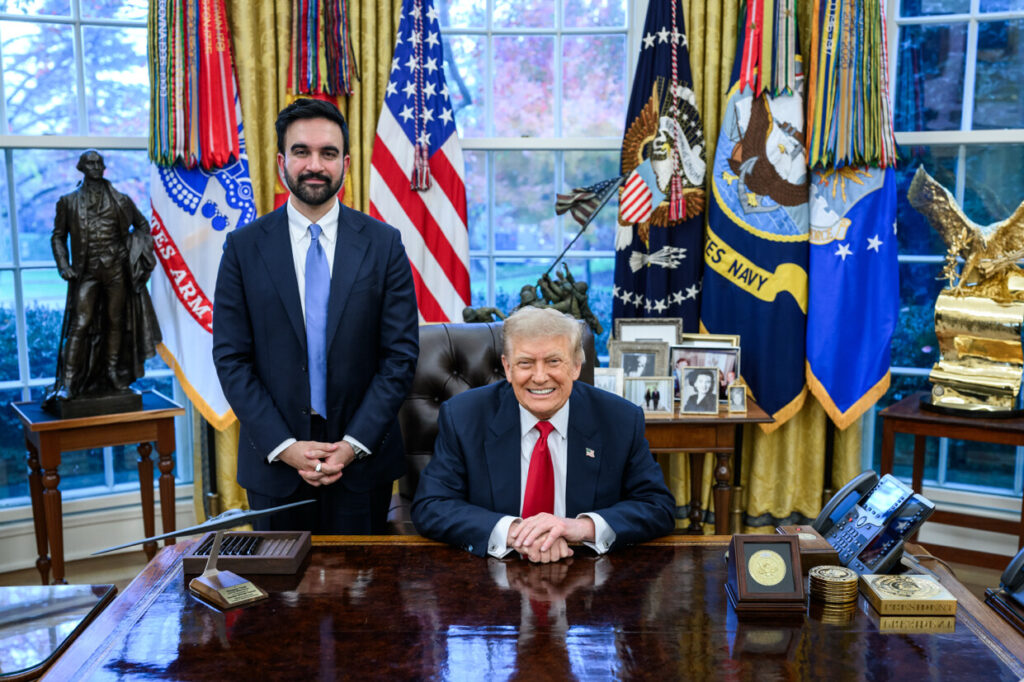
The White House press conference between Donald Trump and New York City Mayor-Elect Zohran Mamdani – two men who had spent months flinging contempt at each other – was a masterclass in the surreal politics of our time. When a reporter asked Mamdani whether he considers Trump a fascist, the former president jumped in before he could answer. Laughing, Trump said: “That’s ok. You can just say yes. That’s easier. It’s easier than explaining.” The room, and with it the nation, tittered. What most expected would be a moment of ideological confrontation instead became a joke – a scene in which the seriousness of political conflict evaporated before the cameras.
This brief, bewildering moment wasn’t an anomaly. It was a distilled instance of what my Belarusian colleague Volha Biziukova and I have called dyspolitics: the collapse of political life into ideological incoherence, performance, and mutually recognized absurdity, where even the accusation of fascism becomes a punchline rather than a serious indictment of rising authoritarianism.
Seen in this light, what unfolded between Trump and Mamdani was not an isolated American oddity. It reflects a broader political formation that has taken root across regimes as different as the United States, Hungary, India, and Russia: the substitution of governance with spectacle, contradiction, and performance. And perhaps nowhere has this transformation been more fully realized – nor is it more revealing or instructive – than in contemporary Russia.
In Vladimir Putin’s Russia, politics no longer concerns the organization of public life or the pursuit of collective flourishing. It has become a performance – a civilization staging its perpetual struggle for survival. Putin describes Russia as a “state-civilization,” an entity defined not by the welfare of its people but by its eternal opposition to the West. This vision has justified everything from the annexation of Crimea to the brutal invasion of Ukraine. But it is more than an ideology of war; it is a vision of politics that erases the Russian people themselves.
Since at least the early 2010s, this civilizational framing has served as a substitute for the failed promises of post-Soviet capitalism. When neoliberal reforms produced intense inequality, loss of shared purpose, and widespread poverty, the Russian state filled the vacuum with identity: Russia was not a struggling economy failing to provide for its citizens but a timeless civilization besieged by decadent Western powers. The story replaced class realities with cultural mythology, transforming material hardship into a test of spiritual fortitude.
Although it facilitates authoritarianism, dyspolitics is not authoritarianism itself. It is the emptiness that follows when politics ceases to mean the pursuit of the public good. It replaces the work of governing with the spectacle of grievance.
Cynicism and faith have fused. Citizens can mock their leaders while still believing that national destiny demands obedience to them. The Russian state offers no coherent ideology, no utopian promise. Its propaganda is deliberately inconsistent – glorifying the last tsar and Stalin in the same breath, condemning the Bolshevik revolution while mourning the collapse of the Soviet Union. The contradictions are the point. As Hannah Arendt once observed of totalitarian propaganda, the aim is not persuasion but the organization of an alternate reality. Today, even the pretense of truth is irrelevant. What matters is participation in the performance of power itself.
Incoherence has become the regime’s strength. As anthropologists like Biziukova and Julie Hemment, among other scholars, have shown, Russian officials deploy absurdist humor and irony as tools of domination – mechanisms for rendering politics unserious even as the state perpetrates sadistic violence. The philosopher Achille Mbembe helps illuminate this logic. In On the Postcolony, he argues that postcolonial African regimes transformed domination into a shared theater of vulgarity. Power made itself intimate by staging its own absurdity – “banal grandiloquence,” Mbembe called it – inviting people to laugh at what they nonetheless must obey.
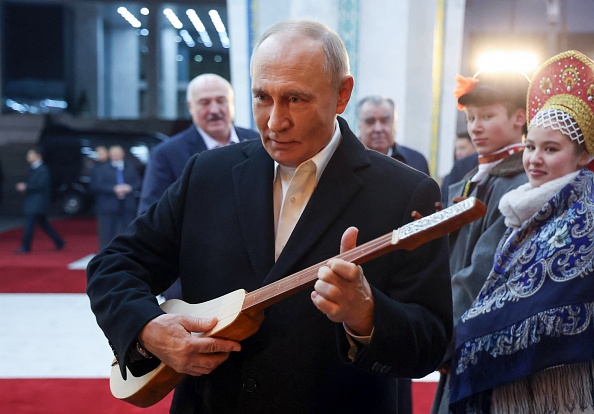
Laughter, far from dismantling authority, becomes its condition of endurance. It makes power feel familiar, cultivating a grotesque intimacy between ruler and ruled in which power parades its own absurdity. Under such conditions, laughter is not the antithesis of obedience but its affective mechanism. It draws subjects into authoritarian participation through shared recognition of the farce, such that mocking and miming one’s rulers becomes the ritual by which domination is renewed. Sovereignty thrives not on belief in truth or ideology but on the public’s willingness to treat power as parody – to recognize its falseness yet continue to act within its spell.
The result is a populace that recognizes lies but no longer expects truth, understands corruption but no longer demands justice. When politics becomes a stage of endless civilizational struggle, the everyday concerns of ordinary people – wages, healthcare, community – are pushed outside the frame of the political.
A Hollowed-Out World
As I write from Chicago – where ICE raids, draconian federal law enforcement incursions, and illegal brutalization of the city’s residents have become a grimly familiar feature of urban life – it is impossible not to hear the resonance of this dynamic with the Trump administration’s carnival of grievance and paired violence. Across the world, from Moscow and Budapest to Jerusalem and Washington, neoliberalism and identity politics have converged in producing the same anti-political order. The governing aim is no longer to build a common life but to defend one’s imaginary side – Putin’s Russian “genetic code,” Stephen Miller and Trump’s “Western civilization,” and countless others – against invented enemies. Politics becomes a bizarre morality play of eternal conflict. The other side is not wrong but evil – “terrorists” who must be eliminated.
Carl Schmitt, the Nazi legal theorist whose ideas haunt modern politics and who is embraced by Trump’s circle of advisors like Stephen Miller, Steve Bannon, and Elon Musk, defined the essence of the political as the distinction between friend and enemy. The global revival of Schmitt’s agonistic politics – not as diagnosis but as prescription – animates Putin’s crusade against “the West,” Trump’s war on fictions like “the deep state,” and Netanyahu’s campaign to destroy Palestinian life in Gaza and the West Bank. The result is a universal phenomenon: the replacement of material politics with civilizational myth-making, or the constant dramatization of who we supposedly are rather than attending to what we actually do and how it harms others.
What Mbembe diagnosed in the African postcolony – the obscene intimacy between ruler and ruled, the carnivalization of domination – has migrated to the metropole. Laughter has been globalized into memes, late-night comedy, and political theater on the floor of Congress. If the postcolony was ruled through farce that enabled violence, today’s neoliberal empires rule through the same: a politics of the ridiculous that replaces collective purpose with spectacle. The postcolonial afterlife of empire has become the political form of the imperial core itself.
In the U.S., four decades of market fundamentalism – the belief that wealthy individuals who control unregulated economic markets, not democratic institutions, should shape social and economic life – have hollowed out the idea of political collectivity. The government became the manager of capital, not guarantor of welfare. Citizens became entrepreneurs of their entire worlds, including themselves. The social sphere, where solidarity and meaning are forged, withered and became so devoid of relationships that it is now easily colonized by social media, ChatGPT, and the substitution of artifice for genuine connection. In this hollowed-out world, culture wars, technofascism, and hypernationalist fantasies have thrived.
In Russia, the fantasy was that the nation’s suffering proved its moral superiority. In the United States, it was that our superficial diversity – regardless of material conditions like rising inequality and oligarchic power – proved our democratic vitality. In both, politics stopped organizing the conditions of everyday life and instead masked their deterioration.
The danger of dyspolitics is not ultimately authoritarianism but something deeper: nihilism. It leaves societies suspended between exhaustion and rage, unable to imagine anything beyond the endless replay of defeat. The public becomes a spectator to its own deterioration. Every new crisis confirms that “this is just how the world works,” or, as Russians say, всегда так было – “it’s always been this way.”
Dyspolitics is the psychic complement to what Mbembe calls necropolitics – the organization of power through exposure to death. If necropolitics names the use of the state to decide who lives and who dies, dyspolitics names the collapse of political imagination that allows such violence to be tolerated, or even desired. When grievance becomes the last shared feeling, participation in destruction becomes the only remaining mode of feeling alive. Both Russia’s nationalism and America’s culture wars channel this same necropolitical desire: to convert despair into vitality through cruelty.
But there is nothing inevitable about our present condition. Politics can still mean more than vengeance, despair, and absurdity. It can still be, as Arendt wrote, the realm in which we “begin something new,” in which the much-misunderstood Freudian death drive is channeled not into destruction but into what Jacques Lacan called “the will to create from zero, to begin again.” The question is how to reinvest in such acts of invention and in a belief in the possibility of a beautiful world full of meaning-making, relationships, and vision in a time when power thrives on meaninglessness, incoherence, and despair.
Reclaiming Politics
The answer begins not with rhetoric or ideology but with a re-materialization of political struggle – grounding politics in the delivery of care, the organization of everyday labor, and the feeling of collective vitality, what Émile Durkheim called “collective effervescence,” that emerges from assembling with one another in shared purpose.
Mamdani’s grassroots campaign – and his conduct in the Oval Office – illustrates these possibilities. He is not relevant here as a personality or political hero, but as a case study in how materialist, constituency-grounded politics behaves under dyspolitical conditions. In his meeting with Trump, Mamdani recognized that dyspolitical authoritarians like Trump thrive on being “in on the joke.” For Trump, spectacle absorbs criticism by turning it into entertainment, converting even opponents into participants in his quasi-fascist charade. Even as he played Trump like a plastic fiddle, Mamdani ultimately refused to play along. Before, during, and after the meeting, he grounded the public conversation in the realities his constituents face: rising electric bills, expanding homelessness, and the rage many feel about their tax dollars funding a genocide in Gaza while children in their neighborhoods go hungry.
Mamdani’s discipline shows that there is a way out of our current trap. It begins not by matching absurdity with absurdity or fascist rhetoric with anti-fascist symbolism, but by making politics real again – by anchoring it in the material ground of everyday life.
Russia’s self-destructive nationalism and America’s partisan culture wars both reflect societies that have abandoned the basic work of meeting people’s needs, cultivating resentment as the last shared feeling and channeling it into violence. Only by rebuilding the material foundations for shared constructive feeling – through caregiving, mutual aid, and protection from state violence and deprivation – can political life deprive fascism of its affective engine and recover democracy’s ethical and imaginative possibility.
The political tragedy of our time is not that people have stopped believing in democracy or socialism or any particular creed. It is that so many have stopped believing politics can deliver anything that feels real at all. That disbelief – the sense that history is a closed loop – is the essence of dyspolitics. And it is ripe for recruitment into aggression by which people seek to feel alive, even if only by inflicting death on others.
To resist dyspolitics, we must reclaim politics itself – not as spectacle or identity but as the collective pursuit of the conditions for a full life, including feeling ourselves not as pawns of history or cogs in capitalist machines but as unique individuals realizing our singular potential together. That means rebuilding faith that government can do good, that public institutions can help us care for one another, and that solidarity across differences is not naïve but necessary for a world worth our belief and participation.
Mamdani’s success makes plain that this kind of materialist politics can still generate power and win – even in the face of unified opposition from powerful Democratic Party leaders, far-right figures like Trump, and billionaire oligarchs. Moments like this underline that the world is not in fact divided into civilizations fated to clash. It is instead divided into those, like Mamdani and the democratic-socialist movement that brought him to power, who still believe in a common future and are willing to fight for it – and those who have given up.
Eric Reinhart is a political anthropologist, psychiatrist, and psychoanalyst.