ESPN’s Slide to the Right
Big-money sports and media have veered to the right, punishing Black journalist and athletes for talking about race and shielding their white fan bases from the truth about the racial politics of sports.
In 2000, DJ Casper, aka “Mister C,” wrote a song called the “Cha Cha Slide.” It inspired a dance that one can hear at any African American cookout, homecoming, grown and sexy party, or Gen Z event. The lyrics song tell listeners, “slide to the right, slide to the left and everybody clap their hands.”
He could have been predicting the political trajectory of ESPN (owned by the Walt Disney Company)—and its decade-long slide to the right. The release in September of Colin Kaepernick’s memoir The Perilous Fight—marking the tenth anniversary of his being blackballed from the NFL for protesting police brutality by taking a knee during the national anthem—is a reminder of the many ways big-money sports and the media that celebrate them serve as a mirror of American racial politics.
When Barack Obama was elected president in 2008, many Americans believed the nation was “post-racial.” Racism had ended, and American exceptionalism and progress were like Thanos: “inevitable.”
In the sports media world, John Skipper took over at ESPN in 2012. He seems to have thought that ESPN’s major demographic was made up of young white males who listened to Hip Hop, embraced Black athletes, had a Black friend —and who appeared ready for ESPN to discuss sports and social issues.
The hiring of NFL star and Super Bowl champion Ryan Clark in 2015 signaled that ESPN was open to this direction. Through his hard work, talent, and personality, he built a large platform. In 2022, Clark, together with Channing Crowder, and Fred Taylor, started “The Pivot” a podcast that discusses race, sports, and politics. As Clark gained more visibility on ESPN, some of his commentary featured discussion of racial issues.
Moreover, in 2017, the appearance on ESPN.com of “Undefeated,” a column dedicated to race, sports, and culture, built on this momentum. Renamed “Andscape” in 2022, it featured the work of many African-American sports journalists, including the veteran William Rhoden.
Since “Andscape” is an online written platform, it has not encountered any white backlash from ESPN’s fanbase. In other words, one can write about racism—just don’t try to discuss it on television.
But ESPN soon faced headwinds following the election of Trump. In April 2016, host Bomani Jones wore a t shirt with an image of a made-up logo of a white person with a “Caucasians” team name. Jones was taking aim at the use of the figure of “Chief Wahoo” by the Major League Baseball Cleveland Indians (now the Guardians).
White viewers took offense and called into the network while Bomani Jones was still on air. ESPN producers apparently told the host to zip up his hoody to cover the image.
The controversy only reinforced Jones’s point. For years, white fans defended mascots for professional, college, and high school teams as innocent symbols of team spirit—even when Native communities rejected them as emblems of racism. Many teams have retired controversial names, but sports fan bases—and franchises—have not found it easy to let go: in August, the NFL Washington Commanders offered a sale of “Washington Redskins” merchandise that sold out in 48 hours. And there remains a brisk market for “Stanford Indian” merchandise, 54 years after the university abandoned the reference.
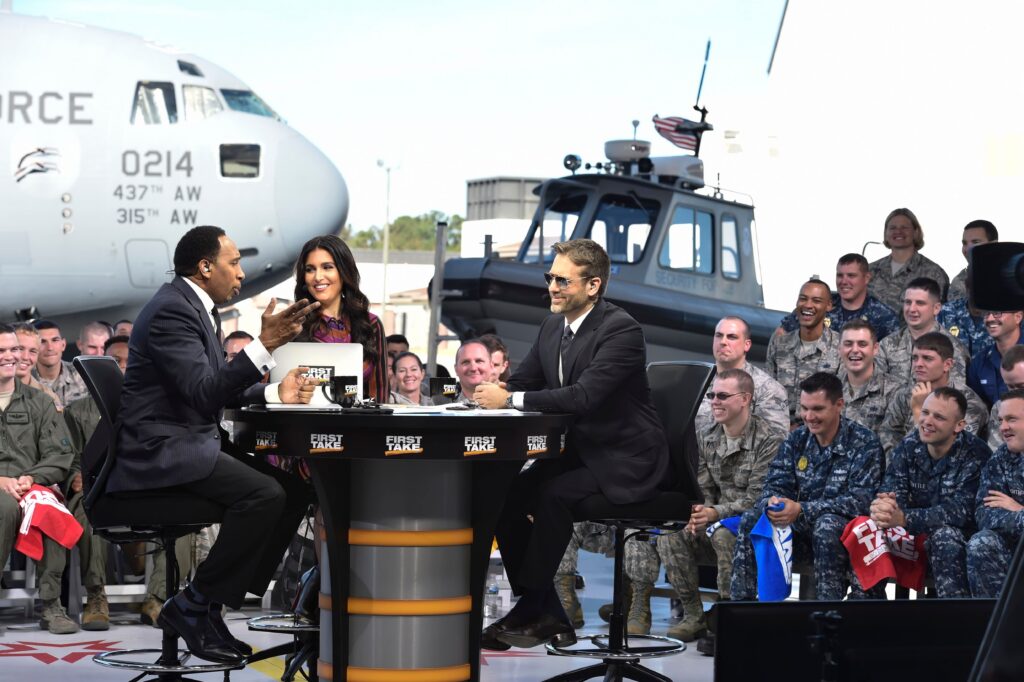
Despite criticism of Jones’s provocative stance, in 2017, Skipper, the head of ESPN, hired Jemele Hill and Michael Smith as co-hosts of Sportscenter, the network’s flagship program. Hill and Smith had co-hosted His & Hers and did famous skits about classic movies such as “Boyz in da Hood” and “Step Brothers” and shows such as A Different World, the late eighties early nineties show about HBCU life, which is currently rebooting on Netflix. Renamed The Six, their primetime show lasted one year, but any reasonable person can watch every episode and conclude The Six was not like watching 60 Minutes, before Bari Weiss or Amy Goodman’s “Democracy Now.”
In 2018, Jemele Hill called out President Donald Trump as a white supremacist on her Twitter account. She resigned from ESPN in the face of the white backlash that ensued.
After Hill’s exit, critical scrutiny focused on Ryan Clark, who on two occasions talked about race and sports. In June 2020, Clark gave an emotional testimony about his son, Jordan Clark, a football player at Arizona State University. According to Clark, a white woman used the N word in a confrontation with Clark’s son at a Whataburger. Five years later, Clark got into a heated debate with ESPN football expert Peter Schrager. Clark violated an unwritten rule in sports television when he told Schrager that his take demonstrated “that’s the non player in you,” drawing attention to the distance separating Black players’ experiences and authority and white experts who were not professional athletes.
A month later, ESPN reprimanded Clark for his comments about Kyren Lacy, a former Louisiana State University football player. In January 2024, Lacy was speeding in traffic, leading to an accident that caused the death of a 78-year-old pedestrian. On Monday Night Football, Clark defended Lacy, who was Black ; however, the following day new evidence appeared to show that Lacy’s reckless driving led to the pedestrian’s death. Lacy died by suicide in a police car chase in October 2025, and the next day Clark apologized for his comments. This was a legal case, and Clark needed to use the term “allegedly” and wait for further evidence. Clark made a mistake, but his defense of Lacy was another instance that fueled the ire of white fans who despised Clark and any Black host discussing racism on television.
A few months ago, ESPN terminated Ryan Clark and 33-year ESPN veteran Karl Ravech as a cost-cutting move. But many speculated ESPN fired Clark because he discussed race and sports once too many times on air. According to Clark, ESPN leaked his termination to Outkick, a right-wing sports, culture, and politics site. During a live broadcast Clark learned about his termination and did not return to complete the show. Many watchers concluded that ESPN’s move was unprofessional, humiliating, and racist because no white ESPN host has been terminated on the air.
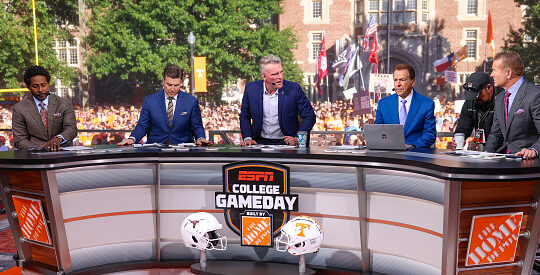
Further evidence of ESPN’s shift appeared in 2023, when they hired Pat McAfee, a former Indianapolis Colts kicker. His $65-million dollar contract makes him the highest paid ESPN personality. (He replaced Lee Corso, the long-time host on College Game Day, who was known for wearing the head of the mascot whose team he predicted to win.) ESPN claimed it could not afford to pay Clark’s million per year salary, but they managed to sign McAfee to this incredible deal.
Many critics complained that “wokeness” had infected ESPN because African American hosts had occasionally infused politics in sports, upsetting ESPN’s number one demographic of 18-49-year-old white males. Yet McAfee gets away with promoting MAGA by performing political ignorance. McAfee has interviewed Trump, attended his MMA event at the White House and Trump’s Patriot Games, an athletic competition for the children of Trump supporters. He knows good and damn well that talking to Trump is great for his brand.
ESPN has even become an outright platform for MAGA politicians. On September 12th, College Game Day invited Senator Ted Cruz from Texas to discuss the Protect College Sports Act, a bi-partisan bill to cap spending on Name Image and Likeness (NIL) deals. University of Texas students booed Cruz—so do not be surprised if the federal government punishes UT for students booing a sitting Republican Senator by withholding research funds.
On September 28th, the Senate passed the Protect College Sports Act (PCSA) by a vote of 77 to 22. The next day former University of Alabama head coach Nick Saban traveled to New York City and appeared live on ESPN’s Get Up and First Take to discuss his upcoming documentary “Saban” and his views about the PCSA.
According to Domonique Foxworthy, ESPN host and former National Football League player, ESPN did not invite him to appear on Get Up to counter Saban’s perspective.
Saban started his crusade to “save college football and to protect players” in May of 2025. Saban met with Trump, who was in town to give the University of Alabama commencement address. Apparently, they discussed Saban’s concerns about NIL and college sports. A few days later Trump signed an executive order, and fifteen months later the Senate approved the bill.
Republicans insist they are creating policies to “protect college sports” and “young girls” from trans-athletes. However, the PCSA has nothing to do with protection, but everything to do with preserving power and privilege.
Power 4 Conference coaches, athletic directors, presidents, ESPN, Fox, TNT, and sports betting sites such as FanDuel make billions of dollars from college football and men’s college basketball, where Black men make up the majority of players. However, the PCSA attempts to cap the salaries of just the mostly Black male athletes—not the coaches who make millions of dollars and receive huge million-dollar buyouts when they are terminated.
Many speculate that NIL forced Saban to retire because he could not monopolize all the top Black elite football talent, and he despised the transfer portal. Recall that Saban failed to win one national championship after NIL became law in 2021.
On Saturday, November 28th the Ohio State University will play the University of Michigan in Columbus, OH in “The Game.” Will ESPN College game Day invite Ohio Senator Sherrod Brown to discuss football and his views on the Protect College Sports Act? And in December, the Southeastern Conference Football Championship game will be played in Atlanta. If the University of Texas Longhorns, University of Florida, or University of Georgia compete in the final, will ESPN College Game Day invite Senators James Talarico of Texas, Angie Nixon of Florida, and John Ossof of Georgia?
After seeing Cruz’s interview on College Game Day, Saban’s appearance on Get Up and First Take, and McAfee’s $65-million dollar contract, the answer has to be “no”—because ESPN has slid to the right.
Dr. David A. Canton is Associate Professor of African American Studies and History at the University of Florida.