How South Africans Became the “Good Refugees”
The debate over South African refugees raises a crucial issue at the heart of American refugee policy: how does the government decide whose suffering merits protection, and what political purposes are served by those decisions?
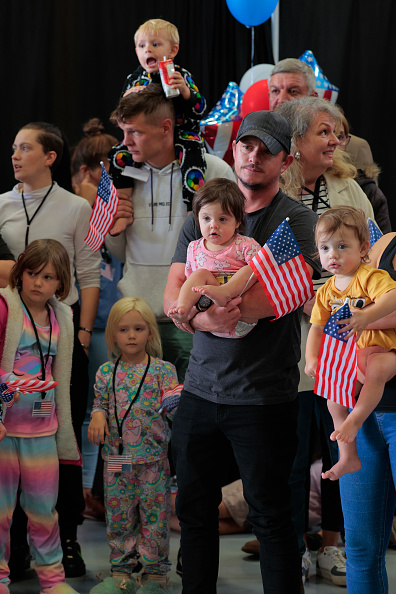
In May 2025, the United States welcomed a group of 59 South African Afrikaners as “refugees.” This relatively modest number was a precursor to the over 10,000 Afrikaners who have arrived since. In fact, Afrikaners currently comprise nearly 100% of all U.S. refugee admissions in 2026—most processed in a fraction of the time asylum typically takes. Afrikaners are a white, Afrikaans-speaking ethnic minority in South Africa who are the descendants of European settlers who ruled during apartheid. They are appearing in the U.S. at a moment when tens of thousands of refugee applications from other parts of the world remain frozen. The warm reception raises a troubling question: how did this population gain access to a system that was essentially closed?
The answer begins with Executive Order 14163, a presidential directive signed by President Donald Trump in January 2025. The “Realigning the United States Refugee Admissions Program” order redefined refugee admissions by dramatically restricting access to the U.S. refugee program while creating room for political exceptions. Previously, the U.S. provided humanitarian protection to nearly 100,000 people a year, from all over the world. But the Trump administration closed these avenues—while creating a special refugee pathway for Afrikaners. The policy shift cast Afrikaners as a particularly deserving refugee population, effectively transforming U.S. refugee policy from a humanitarian effort into one that furthers its domestic political agenda of validating conservative anxieties regarding white minority status globally.
Trump has upended U.S. refugee policy, breaking with policies established over the last eight decades. Before World War II, there was no effective refugee policy apart from immigration policy, which meant that the United States refused to accept Jewish refugees fleeing Nazi Germany in the 1930s. The first U.S. refugee policy was adopted at the end of World War II, allowing asylum for refugees displaced by the war. Following World War II, refugee policy was closely tied to foreign-policy objectives. Groups admitted during this period included those escaping the 1956 Hungarian uprising, Cubans fleeing the Castro regime during the 1960s, and Indochinese populations displaced by the Vietnam War.
Policy decisions were frequently shaped by domestic electoral considerations, civil rights discourse, and the interchangeable use of terms such as “defector” or “parolee” to categorize displaced persons. Following the end of the Cold War, policymakers grappled with a broader, more diverse spectrum of refugee populations alongside increasing numbers of asylum seekers. The landmark Refugee Act of 1980 codified the UN definition of a refugee in U.S. law. It focused on individuals fleeing persecution based on race, religion, nationality, political opinion, or membership in a social group. The rhetoric centered broadly on universal humanitarianism and championing democracy. By adopting an impartial standard to define refugee status, the president’s role involved working with Congress to determine annual quotas.
Trump’s Executive Order 14163 indefinitely suspended the entry of most refugees into the United States by radically redefining what a refugee is. The order equated migration with “compromis[ing] the availability of resources for Americans.” Additionally, it highlighted the need to protect the “safety and security” of U.S. citizens. By linking refugee admissions to diminished resources and threats to public safety, the order upended the longstanding legal framing of refugees as humanitarian subjects who deserve compassion and assistance and portrayed them instead as potential liabilities.
Refugees are no longer presented primarily as people fleeing persecution but as outsiders whose presence must be justified in economic and security terms. The language of “safety,” “security,” and resource scarcity shifts the burden of proof onto refugees themselves, requiring them to demonstrate their value to the nation before receiving protection. The administration’s policy is now “to admit only those refugees who can fully and appropriately assimilate into the United States and to ensure that the United States preserves taxpayer resources for its citizens.” This language treats refugees as financial and cultural burdens who must justify their admission by proving their social compatibility.
Like earlier invocations of “assimilation,” this one is intertwined with questions of race, culture, and national identity. The order’s emphasis on admitting only refugees who can “fully and appropriately assimilate” echoes these longer traditions. The day the first Afrikaner refugees arrived, Deputy Secretary of State Christopher Landau said one of the major criteria for their refugee status was that they “can be assimilated easily into our country.” Notably, when asked in July 2025 whether black or mixed-race South Africans who speak Afrikaans would be approved for asylum, Spencer Chretien, head of the State Department’s refugee and migration bureau, answered that the program is intended for white people. This approach prioritizes skin color as the greatest factor in gauging which populations can “assimilate.” Reduced to being a burden on communities and a potential threat to national interests, non-white refugees are no longer wanted.
Following the Executive Order, the U.S. Refugee Admissions Program (USRAP) has been indefinitely suspended. The administration cut its 2026 refugee admissions cap to a historic low of 7,500 slots. The practical effect of the order extended far beyond Washington. Refugees who had already completed years of screening suddenly found their cases paused for the foreseeable future. An estimated 100,000 conditional refugees and applicants who completed the extensive USRAP screening process remain stuck overseas. Furthermore, resettlement agencies received government stop-work directives and faced funding disruptions, leaving previously arrived refugees and newly arriving individuals without adequate health care, housing, and social assistance.
However, the abrupt dismantling of the program has met with some resistance. Resettlement networks have filed lawsuits, including the class-action case Pacito v. Trump, which sought to force the government to process pending arrivals and restore USRAP operations. Although the U.S. Court of Appeals for the Ninth Circuit largely upheld the administration’s legal authority to suspend admissions, numerous other lawsuits are currently challenging various aspects of the Trump administration’s refugee policy. These include Immigration Equality et al. v. Mullin, a lawsuit challenging Trump’s policy of sending asylum seekers to court without an interview. Other cases seek to prevent refugees already in the U.S. from being detained and deported. Furthermore, an amended complaint in the Pacito case now pleads racial discrimination directly. It asserts that the administration is trying to remake the demographics of the U.S., citing Chretien’s statement on racial criteria in its supporting evidence.
If Executive Order 14163 portrays refugee admissions as a threat to national resources and social cohesion, the South African refugee program raises an important question: what makes this one refugee population an exception to these concerns? The Trump administration’s Executive Order 14204, which outlines the procedures for South African residents seeking U.S. refugee resettlement, offers important clues. The order does more than establish legal eligibility. By specifically identifying Afrikaners as a racial minority population ostensibly facing discrimination, it directs readers toward a particular understanding of vulnerability.
Critics have pointed out that this policy echoes white nationalist language, including the adoption of the term “remigration,” which a retired State Department official described as a far-right European term for cleansing migrants. But the policy also has its backers: the John Birch Society welcomed a recent State Department statement by saying that it proves the “Great Replacement” is not a conspiracy theory. The “Great Replacement” idea is a far-right notion that maintains that the white population in America (and Europe) is being deliberately displaced through immigration and demographic change. The preferential treatment of white refugees suggests that ethnonationalist and even eugenic assumptions regarding who is considered a desirable migrant are now guiding U.S. policy.
What has driven Afrikaners to seek asylum in the U.S. is still poorly understood, but statements from Afrikaner applicants center on new South African laws around property seizure and violence against farmers, as well as the general sense of suffering at the hands of “a reverse apartheid.” South African President Cyril Ramaphosa has countered such claims, arguing instead, “They are leaving because they don’t want to embrace the changes that are taking place in our country and our constitution.” The Trump Administration, however, has accepted the Afrikaners’ grievances at face value and created an exception to U.S. immigration policy specifically for them. This refugee policy reflects the abandonment of an impartial, process-oriented humanitarian policy established with the Refugee Act of 1980 in favor of a policy of white grievance aiming to reverse the trajectory of “The Great Replacement.”
At a glance, the portrayal of Afrikaners as persecuted minorities seems to follow a long pattern in U.S. refugee policy. During the Cold War, both Cuban and Vietnamese refugees were frequently represented as victims of communism. Trump’s public remarks about the Afrikaners rely on similarly emotional language centered on victimhood. Trump claimed that the South African government was using the law to confiscate white-owned land and that Afrikaners were being targeted and killed in a “white genocide” (a claim that has been thoroughly debunked). The White House rhetoric depicts Afrikaners as what refugee scholars call the “good refugee”: a population whose suffering is legible to American audiences and whose protection reinforces broader political narratives. However, while U.S. refugee policy in the Cold War era served to further its foreign policy aims to defeat communism, Trump’s Executive Orders put refugee policy in the service of Trump’s white supremacist agenda – potentially the first time U.S. refugee policy has been used so explicitly to put a thumb on the scale of the U.S.’s racial demographics.
The significance of the South African refugee program becomes clearest when viewed alongside the simultaneous restriction of other refugee pathways, revealing how refugee policy communicates priorities through selective inclusion as much as through exclusion. The U.S. simultaneously paused visas and immigration processing for Afghans and nationals from 38 other countries, pointing to domestic security incidents. Meanwhile, prioritized groups (like the Afrikaner refugees) are processed primarily through application-based programs at the U.S. embassy in South Africa. By contrast, Afghan war allies, many of whom assisted American forces, have spent years in legal limbo overseas, lacking clear pathways for permanent status or family reunification.
The Trump administration has focused on the fact that the white Afrikaners are a racial minority—ignoring non-white refugee populations who are suffering racial and ethnic persecution in their home countries but with almost no recourse to asylum in the U.S. A prominent example is the Rohingya, a predominantly Muslim ethnic minority from Myanmar. They have faced ethnic cleansing and violence, yet admissions from this population plummeted drastically.
By prioritizing only white racial minorities over those facing documented, life-threatening danger, the current policy imperils the global standing of the United States. Humanitarian agencies warn that this selective approach degrades the principle of impartial aid, making it significantly harder to foster multilateral cooperation for future crises. What’s more, other countries may take the U.S. as an example of how to support white grievance and deny refugees, creating a domino effect that essentially halts immigration worldwide and further segregates the globe.
At the same time, the refugee program has become a battleground for domestic culture wars. By allowing political ideology to dictate who receives sanctuary, the government risks dismantling the very principles that once solidified America as a global haven, leaving the most vulnerable populations in a state of permanent legal limbo. Unless the U.S. returns to standardized, fair assessment metrics, the promise of the refugee system will remain largely unfulfilled for the world’s truly displaced people. Ultimately, the South African case demonstrates that refugee status is not simply a neutral legal category, but a politically constructed designation shaped by partisan narratives about suffering, deservingness, and national interest.
Sophia Rothman studies political science at Stanford University.