The Nation and Busification
Ukraine's war effort is often depicted as evidence of national unity. While there is truth to that story--especially by contrast with caricatures depicting Ukraine as always on the verge of fracturing--the war has also exposed and exacerbated deep social divisions, which have gotten worse under a government combining neoliberal dogma, energetic authoritarian tendencies, and persistent corruption and cronyism. This is a side of Ukraine's reality Western media mostly neglect. Busification is one of its starkest manifestations for the vast majority of Ukrainians.
In early January 2025, a Ukrainian news agency reported that Ukrainians had chosen a word of the year for 2024. Polled by “Myslovo,” an online dictionary of contemporary Ukrainian, they selected the “ironic neologism” (according to Wikipedia, on a Ukrainian-language page) “busification.” Or, in the two languages widely used in Ukraine–if politically not equally welcome–“бусифікація” in Ukrainian and “бусификация” in Russian (both transliterate almost identically, as, respectively “busyfikatsiia” and “busifikatsiia”). At the same time, busification also turned into one of the most popular Google search terms on the Ukrainian internet, as the publication Suspilne noted. Ukrainian historian and researcher Marta Havryshko, who follows busification systematically, has pointed out that the year of the word for 2023 had been “mobilization.” As she commented, “feel the difference.”
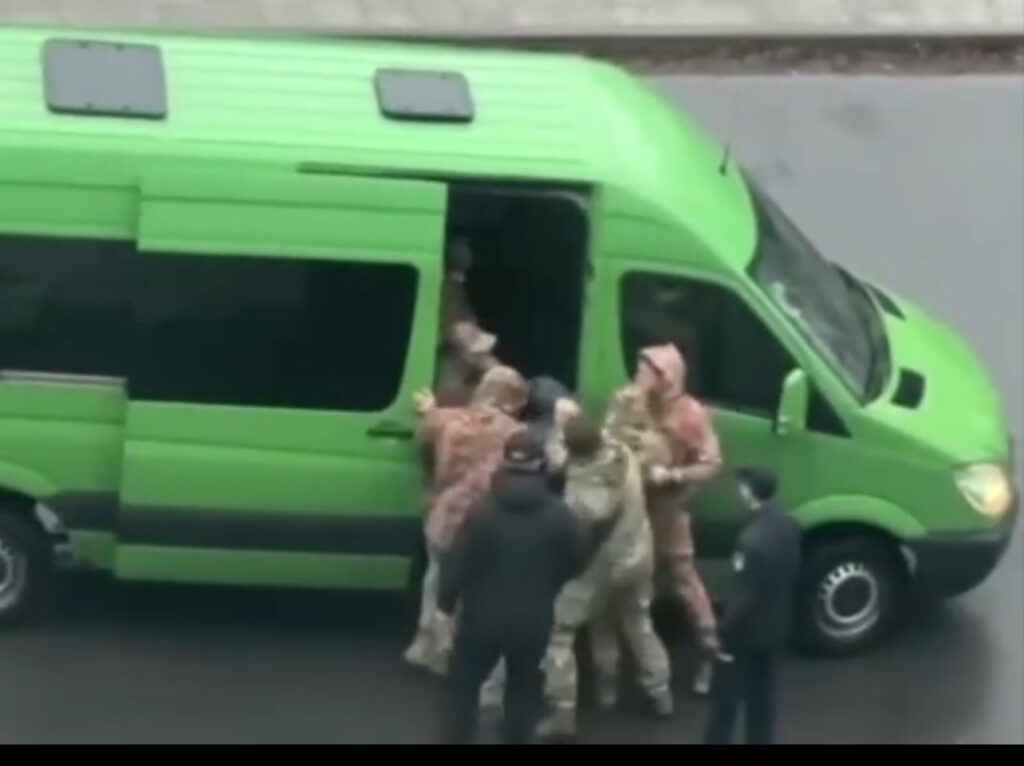
Busification in the most narrow sense of the term refers to a specific method of forced conscription. It features minibuses (or other vehicles big enough to accommodate recalcitrant passengers), into which teams of mobilizers from local recruitment offices–known as “terytorialniy tsentr komplektuvannia ta sotsialnoi pidtrymky” (territorial center of recruitment and social support) or, much more commonly, TTsK (pronounced “Te-tse-ka”)–push men selected on the street or in other public spaces to induct them into the military and, in effect, often into an ongoing and very bloody war against Russia.
The recent experience of a Kyiv high school teacher is typical of this, as it were, classic variant of busification: While he was snatched from a lesson and bundled into a car against his will, at least one of his students recorded the struggle on his mobile phone. That this clip then acquired enough resonance to be replayed on a mainstream media talk show was no less typical.
At a market in the port city of Odesa (or Odessa, if transliterated from Russian, the language its inhabitants often speak), for instance, an angry crowd recently overturned and demolished a TTsK minibus in an attempt to free freshly caught recruits. There has been at least one case of an attack on a TTsK office to free men already taken. Sometimes, the resistance prevails and the men escape. Mostly, however, they do not.
Also recently, the extremely suspicious death of Kyiv resident Roman Sopin in TTsK custody has caused a scandal that has focused public attention on forced mobilization. On 18 October, Sopin, 43 years old, was picked up in the street–at that stage, it seems, without resistance or violence–and taken to the TTsK office in Kyiv’s central Podil district. Five days later, he died in hospital, where the TTsK had transferred him on 19 October with a massive head trauma. The cause of his death, according to an official medical assessment, was a combination of “cerebral hemorrhage,” “fractures of the cranium and base of the skull,” a “closed cranio-cerebral trauma,” and “trauma caused by a blunt object.” In sum, the medical report strongly implies that Sopin was beaten to death, as his family and their lawyer argue.
The TTsK’s claim that their fresh recruit had a black-out, fell on the floor, and injured himself into coma and death is, obviously, ludicrous. The authorities, including the police charged with investigating Sopin’s death, have undermined their position further by a clear pattern of negligence, obfuscation, and stalling tactics, which Sopin’s mother Larissa and the family’s lawyer have been describing in all their Kafkaesque detail on Radio Svoboda, the Ukrainian branch of Radio Free Europe.
Sopin’s tragic case is extreme, but it is not unique. It highlights that for Ukrainians, busification also connotes compulsory mobilization more broadly speaking–as pointed out by journalist and parliamentary deputy (for President Volodymyr Zelensky’s “Servant of the People” party) Heorhiy Mazurashu–including less sensational cases of unwilling recruits who comply without offering open resistance. Hence, busification derives its great resonance in Ukrainian society not only from dramatic manhunts and violent struggles, but also from the fact that it stands for the larger phenomenon of having no choice about entering a wartime army to risk one’s health and life, including, ironically, at the hands of TTsK officers.
Especially in this broader meaning of forced conscription in general, whether involving minibuses and public physical violence or not, in Ukrainian debates, busification also functions as the opposite of voluntary mobilization. It is important to recall here that the first months after the large-scale Russian attack of February 2022 saw a surge of both volunteering for the Ukrainian military and volunteer activism in support of the war effort.
The times of enthusiastic volunteering for the army have long been over. Indeed, Ukraine’s armed forces have been suffering from a severe and escalating AWOL and desertion problem. In October of this year, for instance, the official number of AWOL cases was 21,602. According to Ihor Lutsenko, a member of the Rada, Ukraine’s parliament, a Ukrainian soldier abandons the army every two minutes. Lutsenko deplores a sad record; he also maintains that the real number of de facto deserters is higher again and identifies this as the Ukrainian military’s most important problem.
While October may have set a record, the total of official prosecutions for going AWOL and desertion over the duration of the large-scale war (since the end of February 2022) now stands at almost 290,000. Again, Lutsenko believes that this as well is an undercount because the prosecutors’ offices do not have the capacity to register all the cases that actually occur.
What the official figures do show unambiguously is growth: According to data reported by Radio Svoboda, the number of AWOL and desertion cases (formally two separate categories) was comparatively small in 2022 and started growing moderately in 2023. The rate picked up speed in 2024 and has been extremely high for 2025. For the month of December 2022, for instance, the number of prosecutions for both offenses combined barely exceeded 1,000; in May 2024, there were almost 7,000 cases; and one year later almost 20,000.
Civilian volunteer activity has developed in a different manner. While this phenomenon has received its share of interested publicity–often in a register of celebrating NGOs, “civil-society,” “informality,” and initiatives “from-below” that is sure to please in the West–it is real, nonetheless. And even though the enthusiasm of the first months may have receded or become muted under the pressure of a long and destructive war, volunteer activism is still important. Its effectiveness and resonance have been boosted by the widespread use of social media.
By now, the short but intense history of large-scale voluntary activism has produced two important side effects: According to a December 2024 poll by a reliable institute, 81 percent of Ukrainians have confidence in volunteer activists. Only the military rates higher (92 percent); other key state institutions, such as the president (45 percent), the government (20 percent), and parliament (13 percent) are doing much worse.
Likewise, the initial phase of voluntary activism in particular has left behind a certain nostalgia, as illustrated in a recent discussion between the journalist Serhiy Shevchuk, the lawyer Serhiy Kasianchuk, and Heorhiy Mazurashu. Deploring busification and forced conscription in general as pointless and worse, the three discussants agreed that, in Shevchuk’s words, “true mobilization occurred in the “spring of 2022”–“you remember?”–and was not “compulsory” but voluntary self-mobilization “and not what is happening now.” “People were happy,” Kasianchuk believes to recall.
Busification, on the other hand, stands for a degradation into pure compulsion. It dramatizes–over and over again–the clash of forceful conscription and open resistance. It also renders the public image of the military more complicated, notwithstanding the trust it enjoys in general: Since TTsK officers are members of the military, often injured out of the frontlines, busification incidents amount to an extreme–yet not marginal–and very visible form of interaction between Ukraine’s civilian society and its armed forces: TTsK operations often involve chases, violent struggles, and open resistance by the targeted men as well as their family members, neighbors, friends, and members of the public who happen to be present.
While there is pervasive criticism of the TTsKs, a counter-discourse has also formed, reprimanding civilian society for its unwillingness to do its bit. The outlines of a rift between those with and without a “fronterlebnis” (“front experience”) are clearly taking shape and will matter in any future Ukraine.
While the Ukrainian authorities insist that TTsK officers only use physical force when men correctly identified as liable for service flee or resist, the public image of busification is different. It is widely seen not as an adequate if harsh response to citizens who fail to answer a fair demand by state and country, but as a form of oppressive and invasive injustice. Mutandis mutatis, there are analogies to the impression left by ICE agents staging public manhunts and invading churches and kindergartens.
In Ukraine, the same authorities who argue that force is legal publicly recognize that they are failing to convince much of the population, and that the TTsKs’ reputation is suffering because of busification. Toward the end of 2024, Defense Minister Rustem Umerov admitted that “we are trying to change the paradigm so that […] military service will be an honor and not as society perceives it now: ‘busification,’ TTsK, bad training, and so on.” But that paradigm change has not taken place. At the end of March, Radio Svoboda reported that busification was neither diminishing nor getting less brutal. “Beatings, unlawful arrest, unlawful detention, deliberate running over of people on the road” were continuing, while official promises of reform remained empty. In sum, busification was acquiring a “mass and systemic character.” Only recently, Oleh Baidaliuk, spokesman for the TTsK Kyiv branch has publicly admitted that “people are picking up an anti-TTsK trend,” which is an almost absurd understatement.
The reasons for the persistently grim image go beyond open displays of violence and resistance. Apart from high-profile cases of suspicious deaths in TTsK custody, as with Roman Sopin, allegations of corruption, bribery, and extortion are not merely widespread but virtually universal in Ukrainian society. They are regularly confirmed by proven cases.
Importantly, the public in which busification and related incidents take place is not only immediate–a street, a checkpoint, a bar, a house entrance, public transport, a market, a parking lot, a wedding, or a pop concert, for instance–but also virtual: as in many other countries, in Ukraine as well the use of both mobile phones with cameras and social media is pervasive. Consequently, scenes of busification and the resistance to it have become widespread and powerful representations in Ukrainian society. According to a recent article in Responsible Statecraft, there are “thousands” of clips circulating showing incidents of busification and violence. That may well be a conservative estimate.
Indeed, social media are also being used to share warnings about mobilization squads, as the BBC has reported. Even the local analogue of a popular video game classic, “Grand Theft Auto (GTA),” has been expanded by adding TTsK officer characters catching unwilling recruits.
Ukraine’s traditional media, too, have given busification coverage. Googling the term in Ukrainian or Russian brings up a substantial list of news items. In addition, major Western media, such as the BBC and Al Jazeera, have reported on busification as well, even if much less than its scale, significance, and brutality would deserve, as Ian Proud has pointed out in Responsible Statecraft. In a recent case, the British Sun, a mass-circulation newspaper, has reported that one of its defense editor’s Ukrainian translators was “forcibly press-ganged into his country’s armed services.”
Ironically perhaps, certainly paradoxically, and yet symptomatically, the brutal methods of busification have also been invoked to define how to be Ukrainian against the foil of an imagined Soviet-ness and, by implication or explicitly, Russian-ness. Consider, for instance, two statements: One by Heorhiy Mazurashu and the other by Ihor Lutsenko. Speaking on a national news show, Mazurashu has complained that busification is severely harming Ukrainian businesses and the state budget by disrupting ordinary labor relations and, in addition, making part of the (male) labor force flee abroad. This is not an uncommon argument in Ukrainian discussions of busification; it is also plausible.
What was not unique but notable about Mazurashu’s framing of his criticism was the depiction of busification as based on a “sovieto-slaveholder philosophy.” In a similar spirit, Lutsenko has recently complained that “busification is not mobilization but russification.”
Mazurashu’s original Ukrainian term “sovkovo-rabovlasnytska” has an added pejorative accent that is hard to translate into English: The word “sovkovo” does not simply mean “soviet” but already refers to a popular and, in Ukraine at least, universally understood caricature of being Soviet (“sovok”) which implies cultural backwardness, economic failure, and political immaturity.
Strictly speaking, treating busification as something “Soviet” or “russifying” is, obviously, an absurd argument. But it is also attractive since it seeks to address something irritating about those the speaker and the audience fundamentally identify with or are, at least, supposed to identify with–the members of the TTsK squads serving the state–by re-categorizing it as really belonging to a principally rejected, even abhorrent Other, here sketched as “soviet,” “slaveholding,” and Russian.
In reality, it is, of course, Ukrainians who–on behalf of a Ukrainian state literally at war with Russia and fiercely repudiating everything “soviet” as well as much Russian culture in general–hunt down other Ukrainians, as Mazurashu and his audience know perfectly well. And both know they know: This, in other words, is not a case of attempted deception regarding the substance of what is happening. Rather it’s an act of national self-delineation that involves, as such acts often do, substantial denial.
It is obvious that “sovieto” [“sovkovo” in the original] has two temporal aspects: It refers to a Soviet past of which Ukraine and Ukrainians were an integral part for a short century and, more importantly, during the period of the existence of a first major, modern political entity officially designated and recognized as Ukrainian (the Ukrainian Soviet republic), even though it was not sovereign but subject to the Soviet Union with its pronouncedly Russian core.
Since Ukrainian independence, this has never been a simple legacy. The current war between Russia and Ukraine has provoked politically inevitable simplifications, reducing this past relationship to a caricature of ceaseless repression, unrelenting suffering, and uncompromising resistance. Yet, in reality, inside Ukrainian society, the Soviet legacy as well as the relationship to other things shared with Russia is a much more complex issue that the war has made not less but more pertinent.
One thing busification is not: Neither the practice itself nor its prominence in Ukrainian society are products of Russian interference or information war. It is true that Russian media regularly highlight busification to attack the legitimacy of the Ukrainian authorities and to emphasize the costs of fighting against Russia and–as Russian media would assert–on behalf of Western interests.
On Ukrainian news shows, defenders and representatives of the TTsK offices, such as Baidaliuk, seek to convince the public that popular resentment of the TTsK is the result of a “deliberate information campaign by our enemy,” i.e., Russia. Baidaliuk–formerly a professional journalist–has even demanded to “delete” the term “busification” from media usage. Yet lawyer Kasianchuk is representative, roundly dismissing the idea that widespread rejection of “busification” is the result of a Russian propaganda operation. Instead, he states, “conscription with infringements of human rights,” as depicted, for instance, in Telegram clips is all too real.
A deliberate Russian strategy to exploit the violence of busification may well exist. It would be surprising if it did not. But to any observer of Ukraine with the requisite knowledge of Ukrainian (and, in reality, Russian, too) to follow genuine Ukrainian voices, the notion that busification and its resonance in Ukraine (and beyond) are not “real” is absurd. (On the identity politics and geopolitics of selecting, amplifying, and de-amplifying “Ukrainian voices” for Western attention, Volodymyr Ishchenko, “Ukrainian Voices?” in New Left Review is essential). Dismissing busification as an inauthentic epiphenomenon of hostile propaganda means to deliberately disregard the real experiences of Ukrainians, in particular “ordinary” ones. It would amount, put differently, to fundamental disrespect of those “below” and what war means and does to them.
Tarik Cyril Amar (@TarikCyrilAmar), is an historian from Germany currently at Koç University, Istanbul, and author of The Paradox of Ukrainian Lviv. A Borderland City between Stalinists, Nazis, and Nationalists.