The New German Militarism
It is the summer of 1943. After catastrophic defeat in the Battle of Stalingrad, Nazi Germany’s legions are retreating before the Red Army. That’s the backdrop to the German – and Amazon–produced–movie “Der Tiger” (English title: “The Tank”). Officially billed as an antiwar movie, “The Tank” is anything but. Yet the fact that it is really about five tough men on a lonely commando mission is trivial.
For, just like “The Tank,” most so-called “antiwar” movies are, in reality, war movies, fascinating their Homo sapiens primate audiences with the action, suspense, and drama of fighting, while inviting identification with at least some of those who do that fighting, be they cast as heroes or anti-heroes. Consider, for instance, the American films “Platoon” and “Full Metal Jacket” (both set it Vietnam) or the Russian “9th Company” (set in Afghanistan). Indeed, it is hard to think of any genuine and consistent anti-war movies. Two that probably qualify are the American “Paths of Glory” (World War One on what the Germans called the Western Front) and the Soviet “Come and See” (World War Two on what the next generation of Germans called the Eastern Front).
“The Tank” certainly has heroes, and they form a classical “band of brothers,” Hollywood-style. There is the brave stoic (the commander) with ice in his veins but a humane, even self-sacrificing side reserved for his men, the intellectual and – mild – doubter (in civilian life a teacher of Latin with eternal-student glasses), the urban proletarian (the cursing driver, speaking not with a New York accent but in the demotic Berlin version of German), the man from the country (just not Kentucky or Alabama, but the Austrian Wachau and its vineyards), and, of course, the youngster, innocent, frightened, but, ultimately, up to a – German – man’s job (removing a booby-trapped tank mine).
At the end of the movie (spoiler alert), it is true, the fantastically implausible story of the men in the tank on their way to their own heart of darkness on the “Ostfront” has an unsurprising twist: “The Tank” is really a “Schauergeschichte,” a tale of sublime dread, a sort of “Erlkönig with Tanks” or “Sleepy Hollow and Nazis.” The crew’s militarily bizarre special mission is not, it turns out, real but a near-death experience or vision – think “Jacob’s Ladder” (1990) – confronting the commander with his responsibility for burning to death women and children in Stalingrad. The gray zone crossed by the “Tiger” to retrieve a mysterious and inexplicably important German officer holed up in a remote bunker – think Colonel Kurtz from “Apocalypse Now” (1979) – turns into the equivalent of either purgatory or the road to hell.
The horror, the horror: The audience has been watching, in essence, virtual ghosts mistaking themselves for the living – think “The Sixth Sense” (1999) and also the Russian “White Tiger” (2012), another spooky World War Two tank story that must have inspired “The Tank” but is, unsurprisingly, never mentioned.
But before (and despite) these revelations, the men in the tank are stereotypically attractive in a well-worn, macho way, baiting our sympathy. They also, of course, happen to serve Nazi Germany or, as they keep saying, the “Reich.” Indeed, the tank men are not merely members of the regular German military, the Wehrmacht, but the Waffen-SS, skull-and-crossbones emblems included.
Notwithstanding its especially striking form, this plot device is nothing special. In the 1980s, the extremely successful “Das Boot,” for instance, about a German World War Two submarine sinking merchant ships and their sailors while battling the British in the Atlantic, offered the same artless yet effective combination of identification with German soldiers and a plot that signaled some sanitizing distance from the regime they were actually fighting for: Yes, strictly speaking they are fascists burning and drowning literal antifascists, but you can still root for them. In “Das Boot,” as in “The Tank,” the effect is reinforced by everyone or almost everyone dying in the end, adding the pity that spectacles of futility among the brave may inspire.
Finding ways to feature German World War Two soldiers as heroes and victims while adroitly, or not so much, airbrushing their allegiance to a monstrous state waging often genocidal war has been a special skill of postwar (West) German film-making and succeeded with large audiences at home. Not so much Rainer-Maria Fassbinder, as it were, but the very popular kitsch of Peter May’s “08/15” trilogy, for instance.
Film-making in the former East Germany, incidentally, had its own, different, complicated as well as almost touchingly transparent ways of putting victims and even heroes into German World War Two uniforms, such as in the “Geheimkommando” miniseries.
Hence, what makes “The Tank” interesting and a sign of the times is not only that it invites its viewers to identify with German soldiers fighting against Soviets, certain to be read as Russians, and for Nazism, but that the film has coincided with the rise of a new German militarism.
This New Militarism is a phenomenon that goes beyond the fact of massive, debt-driven re-armament, disturbing as that may be: by the end of the decade, Berlin is planning to have a defense budget the size of those of France and Britain combined and be in self-asphyxiating debt for it. Half of the state budget will go to the military, while Germans are being shell-shocked by ever more austerity, already including a ruthless pension “reform,” that is, in reality, a demolition. A policy that will produce masses of Germans who are very deprived but also very well armed – what could go wrong?
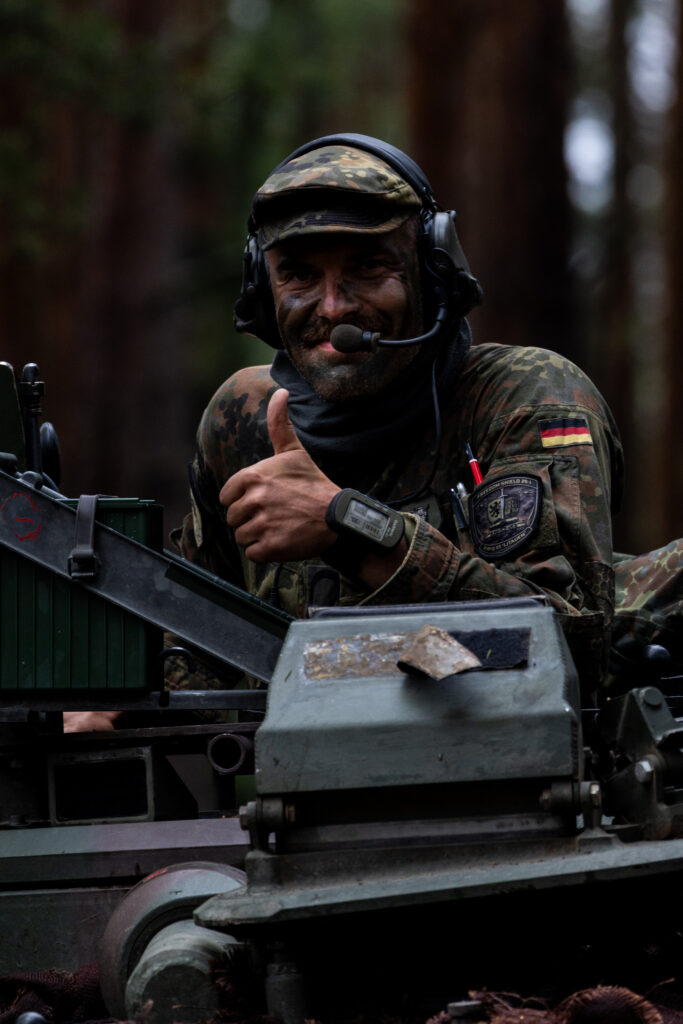
“One of the most dangerous pathologies of our time”
Traditional arms manufacturers – not only in Germany but Europe – have already been through an exorbitant stock market rally. It has come down to earth, but analysts plausibly believe that the popping of that bubble is merely initiating a sustained phase of slower but steady growth. New companies with trendy start-uppish vibes have had a bubble all of their own. German battlefield AI and drone maker Helsing, for instance, which seeks to emulate America’s Palantir and Anduril, has recently seen evaluations that some analysts call crazy and comparable to the dotcom bubble.
Yet modern militarism has never been simply a badly misguided spending priority. Instead, it is a pervasive social and cultural condition. One of its first critics, the German nineteenth-century Jesuit Annuarius Osseg (Georg Michael Pachtler) noted in 1876 that militarism – “one of the most dangerous pathologies of our time” – was a complex syndrome, amalgamating military mobilization, expensive armaments, constant scaremongering about war, and deep transformation: “Gradually,” Osseg observed presciently, “the center of gravity of the whole social life of nations is shifted and directed toward war [and] means of destruction.” A “political atmosphere reek[ing] of gun smoke” and shaped by ceaseless attempts to prepare the public for war was the penultimate, peacetime result. Catastrophic war, he correctly predicted, the final outcome.
In this spirit, despite the relatively short history of the modern concept of militarism (not the phenomenon itself) – not yet two hundred years – and the usual academic tendency to quibble, it is not hard to come up with a working delineation: a state and society with a substantial army and/or a comprehensive reserve mass mobilization system, for instance, are not necessarily militarist; a state and society psychologically, politically, and economically mobilizing around a belief in virtually imminent war and making the armed forces a center of investment, attention, purpose, and identification definitely are.
And so is Germany now, again. Or, at least, that is the relentless strategy of its current political, media, and cultural elites, a strategy that is unfolding not only in budgetary, but also in cultural and psychological terms. But has it found public support? According to a poll conducted a year ago, 67 percent of respondents were in favor of Germany doubling its defense spending by 2032; only 30 percent were opposed.
At the same time, the New Militarism is also meeting some open resistance and widespread reluctance. The German government has, for instance, succeeded in introducing a new version of military service, not yet compulsory but with comprehensive registration and the explicit option of imposing compulsion in the future.
Yet, despite mainstream media coverage that has been monotonous in its support, the policy has encountered a revealing paradox: As with spending massively on more arms, polls have shown a majority (58 percent) of Germans principally in favor of military service. At the same time, they have also revealed an even bigger majority openly declaring that they themselves would not fight, even to defend Germany from an attack. Only a minority is ready to do so: 16 percent unconditionally and another 22 percent with reservations. Even more disconcerting from the government’s perspective must be the fact that those young enough to be turned into effective combat troops – women and men – mostly reject military service (65 percent of those between 16 and 29).
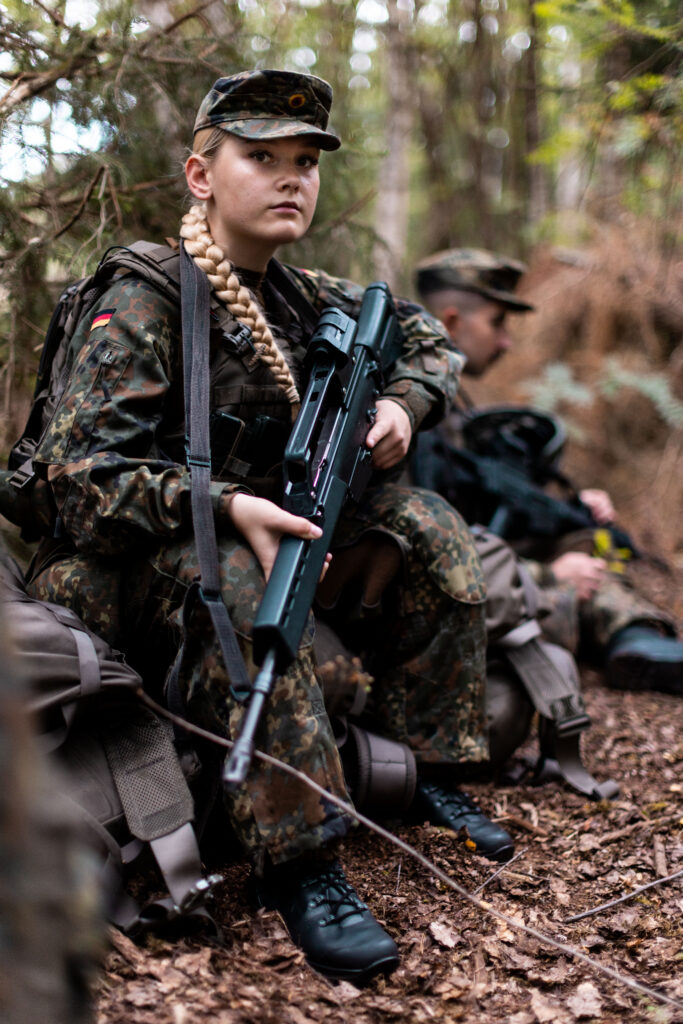
The German army’s new system of obligatory registration for young men is also delivering mixed results. In theory, every 18-year-old male now must fill in a questionnaire regarding their fitness and willingness to join the army (women also receive the questionnaire but are under no legal obligation to answer). Yet even though non-compliance can carry a substantial fine, initially 28 percent of recipients failed to answer. That number was subsequently reduced – presumably by pressure, including those fines – to 4 percent (among women, 96 percent did not answer), but merely 20 percent of young men declared an interest in serving in the military, which is not the same as actually volunteering. Indeed, with the almost 300,000 questionnaires also designed to attract volunteers, only 530 recipients took the bait. In response, Germany’s leaders have signaled that if figures remain low, they will escalate to compulsory military service within a year. In essence, their half-admitted policy is simple: Please, join of your own free will; and if you don’t, we’ll force you.
Yet Germans still have the right of conscientious objection. Even now, the number of objectors has, according to German mainstream and mostly establishment-aligned news magazine Spiegel, “surged.” Meanwhile, it is already becoming clear that the defense ministry’s ambitious near-future growth targets for the Bundeswehr are unlikely to be met without compulsion. Hence, if current policies persist, the draft will be imposed soon, and conscientious objection will become widespread. How Germany’s new militarists will respond is an open question.
The principle of “voluntary compulsion” applies inside the army, too. Germany is in the process of setting up a tank brigade of about 5,000 troops in Lithuania. Accompanied by much hype, this is the first major combat unit of the Bundeswehr permanently stationed abroad, a prestige project to represent Berlin’s claim to protecting NATO’s so-called “eastern flank,” which happens to be identical with what earlier generations of Germans used to regard as their natural backyard in eastern Europe. And, if it goes up in flames, with what is still remembered as the “Ostfront.” Up until recently, the ministry of defense kept denying that soldiers would be posted to Lithuania against their will. Clearly, though, enthusiasm has been limited among the ranks, and the ministry is now acknowledging that, if need be, marching orders will be just that – orders.
German bestsellers also tell an ambiguous story: There is a flourishing, sensationalist yet monotonous, genre of “Russia Attacks!” speculative political fiction, often written in the popular “scenario” mode (think Tom Clancy but with conventional credentials and plenty of “security” “think” tank jargon). Its producers, such as German Army academic Carlo Masala or NATO “futurist” Florence Gaub are presumably doing well in financial terms.
Yet Ole Nymoen’s Why I Would Never Fight for My Country: Against War Proficiency as a National Virtue (Warum ich niemals für mein Land kämpfen würde – Gegen die Kriegstüchtigkeit) has been a great success as well. And where Nymoen, born in 1998, has made a case for just saying “no” to the New Militarism, other, more senior authors – some with impressive backgrounds in the military and in politics, such as former Generals Harald Kujat and Erich Vad and elder statesman Klaus von Dohnanyi – have achieved public resonance with calls for a return to a cautious foreign policy and warnings of the devastation an open, direct shooting war with Russia would produce.
A joining of paths
Even if it’s still a hard sell with many young Germans and not yet able to drown out all opposition, historically speaking, there is no need to explain why German militarism is a thing to take very seriously if you spot it. Yet history – applied daftly (as with bellicose publicists for whom it is always 1938/1939 somewhere the West wants to fight and regime-change) can mislead. It would in this case as well.
For the New German Militarism is just that: new. It has a history, obviously, and important parts of that history are what you would expect, including, say, the Prussia of “Soldier King” Frederick William I, who actually fought little but was a traumatic father to would-be philosopher king Frederick II “the Great,” who could not stop fighting.
But even when duly purged of personality cults, enriched by the many German histories beyond Prussia, reaching below kings and emperors, nobles and ambitious bourgeois, and, of course, with appropriate attention to how badly it all ended – not once but twice (and counting?) – that traditional story of the making and self-unmaking of German militarism between about 1701 and 1945 alone would be a wretched guide to understanding the present or guessing the future.
For the new German militarism has emerged from a convergence of two political and cultural trajectories that seemed – or were construed to be – mutually exclusive: on one side, a grim if banal story of weaponized bigotry, nationalist conformism, and devastating aggression that served as a sturdy, loadbearing beam in the gloomy national-identity-gone-Frankenstein edifice known as Germany’s “Special Path”: the “Sonderweg,” underpinning postwar (West) Germany’s peculiar brand of dark exceptionalism.
And, on the other side, an equally stale tale of redemption from that “Sonderweg” road to perdition or, to be precise, the total national catastrophe that was its destination. This has been first West Germany’s and then post-1990 united Germany’s “Long Way to the West” (“Der lange Weg nach Westen”). Yet another path, it is, in essence, an intellectually derivative yet resonantly melodramatic tale of the German people roaming a desert of belated nationhood and misfiring modernity but finally redeemed in a pardoned land of democracy, markets, and mandatory liberal cultural hegemony, whether of the “free”-market or “social”-democratic variety. Think of it as an especially stodgy and insecure variant of Jean-Claude Michéa’s dominant liberalism refracted through total defeat, specious shame, and eager striving.
In NATO as well as the EU, this Germany, the synthesis of “Sonderweg” and “Langer Weg,” is characterized most of all not by, as often assumed, guilt and remorse. In reality, its most emblematic self-expression is a strutting, massive Holocaust Memorial at the heart of Berlin that betrays a perverse pride in the national patent way of “coming-to-terms” with a genocidal perpetrator past (“Vergangenheitsbewältigung”). Since this my-shame-is-bigger-than-yours maze of sharp-edged, extra-smooth, and very cool designer anthracite concrete has, at best, made no difference to Berlin’s obstinate support for Israel-while-genociding, we now know empirically that it cannot have been about true contrition.
In a post-1990-unification Germany whose dominant culture, political and otherwise, is still thoroughly rooted in the former West Germany, it is this unexpected, if perhaps, in retrospect, expectable Sonderweg-Langer-Weg chimera that is now shaping – at high speed driven by obsessive, anxious urgency, as if to catch up with a national destiny once more – its very own variant of militarism: rooted in more than one past, transformed by a Hegelian complicity of seeming opposites, and thus new.
Regarding the budget politics of the state, the signature pattern of the New Militarism is easy to spot: Spend lavishly on the military even while the economy is in a long and unprecedentedly severe macroeconomic crisis, probably already causing irreversible decline. Going into exorbitant – and since early 2025 explicitly potentially unlimited – debt for guns in peacetime is one thing. Doing so when you have badly run out of butter is quite another again.
Seeking to manufacture consent for this worst of all worlds of ruinous public debt combined with cruel austerity, expert propaganda promises a weaponized Keynesianism: building military vehicles, for instance, is supposed to make up for the German auto industry’s unprecedented and nationally devastating crisis; developing killer drones to help Germany finally abandon its embarrassing culture of the fax machine in order to widely adopt 21st-century technology: The minister of the economy Katherina Reiche has touted the armament spending spree as promoting artificial intelligence, an idea sane people would find scary in more than one way. Striking a more demotic note, Carlo Masala, the ubiquitous Army academic, has implausibly speculated about the armament boom as an “employment engine.”
These promises ignore the empirically grounded differences between macro-economic multiplier effects: substantial when, for instance, spending on education and almost non-existent for weapons. As another sign of how far some Germans, including think-tank-based experts, are now willing to go in abandoning reality, such appeals are disturbing.
Transforming the home front
The New Militarism really comes into its own in the sphere of ideology and cultural transformation. For years, Germany’s political establishment and its reliable mass media have engaged in a campaign of changing public perceptions of military force, political necessities, and national interests to produce that “Kriegstüchtigkeit” which Nymoen has openly rejected.
Before “Kriegstüchtigkeit,” the postwar German lexicon did, of course, already have a term to designate the ability to defend the country: “Verteidigungsfähigkeit.” It is one of the messages of the “Zeitenwende” (meaning a great turning-point) that such sober and sufficient language is not considered fierce enough any longer. Indeed, General Carsten Breuer, the highest-ranking officer of the German military has been explicit: “Kriegstüchtigkeit,” he has explained in Germany’s premier and conformist news magazine Spiegel, means much more than “Verteidigungsfähigkeit,” namely a “mentality transformation” and a “mental turnabout” not only inside the military but society as a whole.
The introduction of “Kriegstüchtigkeit” was really a revival and, probably by design, an Overton Window-shifting provocation which succeeded. As a minority of marginalized critics, who failed to make an impact, pointed out, arch Nazi Joseph Goebbels repeatedly called for “Kriegstüchtigkeit” during World War II, occasionally referring to the material capacity to wage war but more often to the psychological commitment to fight and endure among Germans as well as Nazi allies (in his diary, Italy’s “Kriegstüchtigkeit” received, in effect, an F, Japan’s a patronizing B+). Unsurprisingly, “Kriegstüchtigkeit,” for Nazi Germany’s chief propagandist, too, was a matter of attitude.
Even outside its Nazi context, the term is difficult to translate. Think of its “Tüchtigkeit” component as expressing virtue but mostly not in our contemporary, essentially moral sense, but in the register of Machiavelli’s Renaissance “virtù,” that is, a meritorious capacity that secures power and can be cultivated or neglected. If fostered, it turns into proficiency, and in the case of the contemporary German use of “Kriegstüchtigkeit,” that proficiency is most of all national. Individuals must make their patriotic contribution, but the result is supposed to be as collective as modern nation-state war itself.
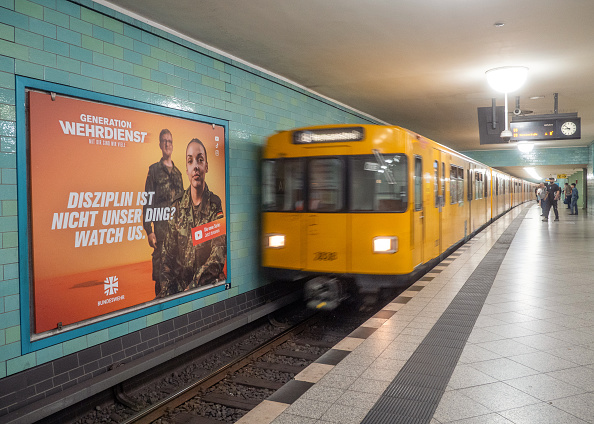
This war-proficiency-as a-national-virtue has been at the core of a ramified, well-funded, and pervasive complex of military outreach and PR. In lockstep with the NATO concept and de facto strategy of “cognitive warfare,” Germany has been subjected to ceaseless advertisement campaigns and propaganda sessions in schools, at sports events and gaming conventions, and obtrusively one-sided write-ups and TV reports about volunteers finding purpose in military training (whether full-time or after work). In some cases, high-school students who have dared to openly resist this militarization drive have faced mainstream media smear tactics depicting them as tools of dangerous “leftwing extremists” as well as intimidation not only in their schools but by representatives of the domestic intelligence service.
“Kriegstüchtigkeit” is not merely meant to be collective. It is designed to be comprehensive and pervasive: again, as with “cognitive warfare” in general, in Germany, too, all of society is the object of Zeitgeist-shaping operations euphemized as defensive measures to build “resilience” against hostile (that is, Russian) attack. In reality, the main target of this aggressive approach is the home front.
This is why NATO and German think tankers, high-ranking military officers, and political leaders have been stressing that the preparedness, resilience, and motivation that they are trying to foster is not meant for the military or even various emergency services and first responders alone. On the contrary, the militarization drive at high speed is officially and insistently presented as aiming at everyone. André Bodemann, the general leading the development of a comprehensive national plan to mobilize Germany as the “hub” of a future open NATO war against Russia, has stressed that the “most urgent” task is to recognize that this mobilization is a “whole-of-society” (in German: “gesamtgesellschaftlich”) effort.
Bodemann’s proud admission is representative: the textbook militarist ideal of removing the distinction between civilian life in peacetime and comprehensive, all-absorbing readiness for war is now official and constantly reaffirmed – if still imperfectly implemented – policy in Germany. And what euphemizes itself as a “whole-of-society” approach could easily be labeled more succinctly and truthfully: Germany’s establishment has set out not only to produce “Kriegstüchtigkeit” but to make it total, too.
It is this context that reveals the purpose of a widespread new habit: German politicians – including Chancellor Friedrich Merz – and their expert and media retinue now love to claim that their country is not yet at war but also no longer at peace. Of course, this makes no sense at all, neither in factual nor even formally legal terms (in which such a situation can, in essence, exist, under the name “state of tension” – “Spannungsfall” – which has, however, not been declared).
But as part of the mentality transformation that has been declared policy for years, this Orwellian obfuscation is directly targeting German society’s ability to distinguish between war and peace. Trained and manipulated to believe that permanent, pervasive “Kriegstüchtigkeit” is a condition of political if not national survival, its members are also learning that peace can neither be defended nor risked, as it has been lost already. This is an absurd message apt to induce derangement: Ready yourself for war as if you have nothing to lose, or you will lose everything.
And this loss is, of course, blamed on Russia. At bottom, the single-mindedness behind the material and mental re-armament drive comes with two corollaries: a dogmatic and one-sided view of Russia and a self-induced case of foreign policy tunnel vision. Both can be traced back most obviously to 2022, the year of the so-called “Zeitenwende.”
But, as Ingar Solty and Jürgen Wagner have pointed out, powerful parts of the German establishment have worked on a turn toward a more aggressive model of military power and foreign policy since well before even 2014, when the Ukraine Crisis of late 2013 escalated.1
Indeed, some of the military spending priorities associated with the “Zeitenwende” were already set in 2021. At the same time, February 2022 marked a clear escalation, in particular in the public sphere. Since former chancellor Olaf Scholz’s “Zeitenwende” speech, delivered three days after Russia’s invasion, and the rapid establishment of a new “special fund” for re-armament, the German mainstream elites have marched in almost perfect lockstep in a virtually complete – and highly intolerant – consensus that what Germany must do is not just restore a substantial degree of military power but acquire more of it than any other state in Europe, as the current Chancellor Friedrich Merz and Minister of Defense Boris Pistorius have openly declared.
This agenda received another, massive boost in March 2025, when Scholz’s successor Merz deployed tactics that the New York Times has euphemized as “democratically dubious” by re-convening a parliament already superseded by elections to change the constitution and open the way for, in effect, unlimited armament spending. This unusually open act of bad faith and brutal defiance of decency has, incidentally, turned into a major boost for the new-right/far-right AfD party.
For now, the ambition to build the strongest army in Europe is officially restricted to the domain of conventional weapons. And it is true that, in legal terms, Germany acquiring its own nuclear weapons would face, at least, the double obstacle of the 1968 Nuclear Non-Proliferation Treaty and the 1990 Treaty on the Final Settlement with Respect to Germany (AKA the Two Plus Four Treaty). Yet ruling out such a turn would be premature and complacent.
Likely to be especially relevant in practical terms are hypocritical suggestions – advanced for instance by the neocon-Green former Minister of Foreign Affairs Joschka Fischer – to make such nukes “European.” That, after all, is exactly how postwar West Germany and then post-unification united Germany has always built much of its power: to quote a once well-known book title, in Europe’s name: The Berlin-Brussels switcheroo is one transparent, yet effective, trick German diplomacy still knows how to pull.
Whether with or without future nuclear weapons, the Zeitgeist of the “Zeitenwende,” as dissident political scientist Ulrike Guérot has noted in her 2025 book Zeitenwenden, is a fresh iteration of the old Thatcherite TINA (There is no alternative) syndrome. As if, one might add, this noxious mindset had been weaponized further from its class-war drive for austerity and mass dispossession to include literal war on a grand (at least) European scale as well.
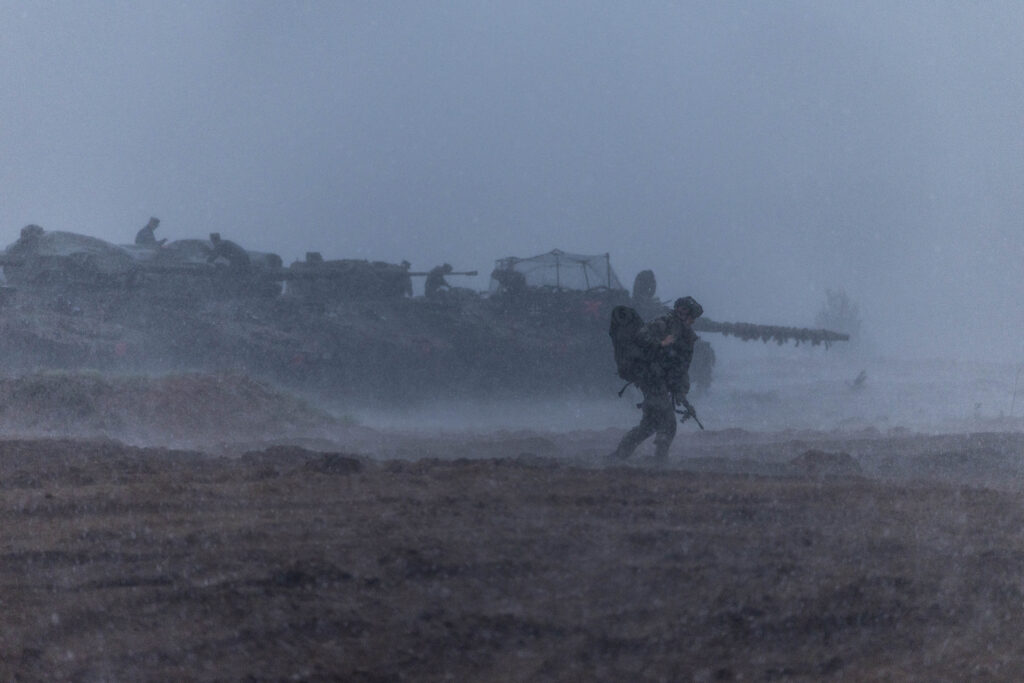
The Eastern Front – again
Arming Germany – and Ukraine – to the hilt and into ruin, this self-imposed fatalism is based on a single dogmatic assumption: namely that this policy is the one and only possible – practically and morally – answer to the Russian attack on Ukraine, while the latter is not merely condemned but, more importantly, willfully misunderstood as having no reasons other than Moscow’s or even Vladimir Putin’s aggressiveness.
Much of the war’s pre-history is subject to intolerant denial, making it difficult to publicly consider or even recall the facts of Western overreach and deception, including the broken no-NATO-expansion promises of 1990 and 1993, the kiss-of-death promise made to Ukraine in Bucharest in 2008, and (as now admitted) the deliberate misuse of the Minsk II Agreement (the best, UN-supported off-ramp there was after spring 2015) and its Normandy implementation format as delaying tactics. Russian warnings and offers to negotiate, on the other side, are caricatured as blackmail or information warfare. Those openly dissenting from this strict orthodoxy are marginalized.
It was, hence, not simply the Ukraine War or even its 2022 escalation as such that were deployed to escalate the New Militarism. Rather the framing of the causes of the war was decisive, as it created the basis for a second de facto dogma also imposed with intransigence: namely that if Russia or “Putin” prevailed in Ukraine, Moscow would attack other countries next, such as the Baltics, Poland, and Germany, too.
With Russia caricatured as having no rationally understandable interests or concerns that could be addressed by the give-and-take of diplomacy and its leadership as motivated by literally limitless bloody-mindedness and delusion – “Putin wants to rebuild the Soviet system,” “Putin wants to rebuild Stalinism,” “Putin lives in another world,” “Putin is stuck in the nineteenth century,” “Putin wants to rebuild the Russian Empire” – it seemed to follow that the options for responding to the attack were radically reduced to military force alone.
Whether by proxy or deterrence: with “the Russians at the gate,” in the words of prominent German (and NATO politicians), politics have been simplified into a very simple choice, deep-frosted Cold War-style: “to learn to defend ourselves or to learn Russian.” In practical terms, the alternative to “learning Russian” can then only be conceived of as joining a Western proxy war against Moscow, where Berlin has by now taken the lead, and launching the biggest armament and mobilization drive in post-World War II German history.
Payback fantasies included. Consider, for instance, the case of Roderich Kiesewetter, a high-ranking parliamentarian from Chancellor Friedrich Merz’s mainstream-conservative party. Kiesewetter, a former NATO staff officer, is a member of the German parliament’s foreign policy committee as well as a prominent public commentator. His position toward Russia has always been uber-hawkish. He has argued since 2024, for instance, that “the war must be brought home to Russia” and that Berlin should “do everything to enable Ukraine to destroy not only [Russian] oil refineries, but also ministries [and] command posts.”
While Kiesewetter’s extremism has sometimes wrongly been dismissed as unrepresentative, his prescription – minus, for now, bombing Moscow ministries – is an accurate description of Berlin’s current policy. He is, clearly, typical and influential, if perhaps especially outspoken and simply faster than the average in deriving awful conclusions from bad ideas. And it is Kiesewetter who has also made a psychologically intriguing statement: “Russia,” he has declared, “must learn to lose the way Germany lost in 1945.”
Wishing for Russia’s defeat, even collapse and dismemberment is, unfortunately, not uncommon in the West. Indeed, without the idea of inflicting a geopolitically crippling setback on Moscow, the Ukraine War would either not have happened or been over quickly. Yet, clearly, there is something special about a German fantasizing about Russia suffering like Nazi Germany, especially as it was, of course, the Soviet Union, with its Russian core, that made the key contribution to that Germany’s total defeat.
Not much more than a generation after re-unification, Russia is, again, at the core of Germany’s New Militarism. Or to be precise, a Germany return to imagining Russia not merely as a defining and principally hostile Other but as a bizarrely crude caricature of a country, driven by aggression for aggression’s sake and beyond the reach of reason and negotiation. In that regard, the New Militarism reproduces bad old traditions.
But there are two important differences: First, a proud sense of having proven itself an important, even over-achieving member of the West is essential to Germany’s New Militarism. This escalation comes with a German chancellor claiming – realistically or, much more likely, not – a “leading role” in Europe and NATO. The toils, abasements, and anxieties of the “Long Way West,” it seems, are finally paying off.
In retrospect, it turns out that it was not the re-unification of 1990 that marked Germany’s full redemption from the failures, defeats, and haunting ghosts of the “Sonderweg”. Instead, it is turning against Russia again, but this time not from a position of insularity combined with a histrionic and insecure sense of cultural uniqueness and mission, but with the hard-earned entitlement of representing – perhaps even ersatz-leading – not a pernicious national aberration but a West imagined as normative and superior.
At the end of the film “The Tank,” the commander finally wakes up from his delusional trip to save the “Reich” in a strange twilight zone between life and death, reality and imagination, between the frontline and a fantastic, doomed destination farther east, just before crashing to an end that was inevitable from the beginning. Germany’s New Militarism is now sending its people into a bizarre gray zone, where peace is declared already lost, war practically inevitable, and national military proficiency the solution once more. And all to save this time not merely Germany but the West and, most of all, Germany as the West. The delusions come and go, German militarism abides.
Tarik Cyril Amar (@TarikCyrilAmar), is an historian from Germany currently at Koç University, Istanbul, and author of The Paradox of Ukrainian Lviv. A Borderland City between Stalinists, Nazis, and Nationalists.
footnotes
- 1 Ingar Solty, Innere Zeitenwende (2026); Jürgen Wagner in Die große Mobilisierung (2025).