The Banishment of a “Rancorous Peacenik”
Views that break from the militaristic consensus on the Russia-Ukraine war are increasingly unwelcome in Europe, their authors mobbed online and subjected to political persecution. Only the war machine benefits.
On the day Putin held a sham referendum that formally sealed the annexation of the Crimean peninsula in March 2014, I decided it was time to part ways with my country of citizenship, the Russian Federation. People who knew me in Moscow remember that I found Putin’s regime abhorrent practically from the outset. Moreover, by that time Ukraine had turned into my main field of expertise, and I was taking things happening there close to heart. I moved to Latvia and lived there for the next 12 years.
But last month I was declared persona non grata in this country, my only home and the land of my ethnic Latvian ancestors. I believe it was a reprisal for my journalistic work and my opinions on the Russo-Ukrainian conflict.
When I protested on X, one far right Latvian politician likened me to a rodent pest that needs to be finished off. “The rat is still kicking,” Andris Velps wrote.
That chilling comment stayed in mind as a particularly vivid illustration of the psychopathic and sadistic political culture that has evolved over almost thirteen years of the Russo-Ukrainian conflict. This culture, as I have realized over these years, was imposed on Western societies by the beneficiaries of this conflict, primarily defense industry lobbyists, who strive to destroy any safe space for an intellectually honest conversation about it.
My expulsion happened in the context of this year’s parliamentary elections in Latvia. Velps ran on the list of the extreme far-right party Austošā Saule (Rising Sun), which emerged in 2020 by splintering from the far larger Nacionālā apvienība (National Alliance). Once upon a time, I inadvertently precipitated that schism and with it – a chain of events that led to my expulsion.
In 2019, I co-authored a story, published by Latvia’s main investigative outfit Re:Baltika, about the links between National Alliance, a government party at that time (as well as now), and Russian neo-nazis from the Wotanjugend platform who found a new home in Kyiv and inside the extremist far-right Azov movement.
In March 2019, circulated the Russian translation of the manifesto released by Brenton Tarrant before he killed 51 people in two mosques in Christchurch, New Zealand. They were also the organizers of what was perhaps the world’s largest festival of NSBM (national-socialist black metal) in Ukraine. Monitoring their social networks, I noticed that a Latvian delegation, made of National Alliance (NA) members, attended that festival. One of them even read a lecture at the quasi-academic conference called Pact of Steel, after the Hitler-Mussolini pact, held as part of the gathering.
NA’s secretary-general Raivis Zēltits had to quit his post and the party following the of our article. He went on to found Austošā Saule and ran on its list this year, together with Velps.
As for me, that story unleashed an industrial-scale campaign of smear and intimidation which lasted for seven years and culminated in my expulsion this year, after NA grabbed the interior minister’s post in a cabinet reshuffle last June. In one of the early episodes, NA MP Jānis Iesalnieks reacted to my article by posting a picture of a grave accompanied by a reference to Latvian funeral traditions.
Democratic governments don’t normally declare critical journalists personae non gratae, an extrajudicial tool designed for diplomats who enjoy immunity from prosecution. It is what authoritarian governments do, and Putin’s Russia is prominently one of them. The fact that Latvia chose to apply it against a journalist and a permanent EU resident, who also happens to oppose Putin’s regime, is emblematic of everything that’s wrong about how the EU and the West at large are tackling their conflict with Putin’s Russia.
I have never been told what I am being punished for – the Latvian authorities chose to classify the reasoning behind it as state secret. All that I know about the accusations derives from tweets by senior Latvian ministers and the of the character assassination campaign waged against me by government-linked infowar mobs on X around the time of expulsion.
My expulsion was initiated in the context of Latvian parliamentary elections (held on October 3) by National Alliance’s interior minister Jānis Dombrava. In a tweet posted on September 30, he accused me of various thought crimes, such as “speaking about the ineffectiveness of Western sanctions” against Russia, “criticising the West” and “discrediting Ukrainian armed forces.” The latter charge sounded especially ironic, being directly copy pasted from Kremlin’s draconian laws on discrediting the Russian army, the prime reason why I haven’t travelled since the start of Russia’s all-out invasion of Ukraine.
But despite being in charge of both migration and state security services, Dombrava didn’t wish to take political responsibility. He insisted that I should be dealt with through an extrajudicial procedure, which only foreign minister Baiba Braže could apply. In the ensuing exchange on X, his advisor Rihards Kols clearly explained why this is necessary. Without it, he said, “the state will lose in court.”
Braže, who represents the right-wing Jaunā Vienotība (New Unity) party, initially refused, pointing the finger back at Dombrava. But something changed when the votes were counted, so on October 7 she declared me persona non grata. She said it was a joint decision by herself, Dombrava and the populist prime minister Andris Kulbergs who had just won the election by a landslide following a Trump-styled campaign driven by TikTok videos and emoji-heavy tweets. Braže’s and Dombrava’s parties emerged as his party’s most likely junior coalition partners.
I issued a statement on X. Among other things, it said: “I condemn the Russian aggression and support Ukraine’s sovereignty over occupied territories.”
It was the same statement I was called a rat for by Velps. Quite unexpectedly, prime minister Kulbergs also chose to weigh in. He subtweeted my statement saying, “We [Latvian flag] were way too patient, way too tolerant to accept such misleading, Russian aggression justification.”
The sheer absurdity of the accusation, rendered in the premier’s trademark style – with multiple flag emojis, encapsulated something that I have observed over seven years of being terrorized by government-linked infowar mobs and pro-war politicians.
It was the combination of a blatant, outlandish lie with the startling lack of even superficial empathy, not to mention remorse for enacting brutal psychological and material damage upon a human being who – as Kulbergs very well understands and as publicly confirmed by NA officials – is innocent of any real crimes under Latvian or European law. Though stylistically different from Velps’ comment, it conveyed the same sense of sadism and self-satisfied impunity.
All of these are features that define a collection of psychological traits historically known as psychopathy. I am in no position, of course, to diagnose individuals. But as a long-time observer of the Russo-Ukrainian conflict and now a victim of dark, tyrannical forces it has unleashed on both sides of the frontline, I believe I can diagnose the culture that has emerged in the warmongering community.
Both Kulbergs and Velps are quite possibly not in any way neurodivergent, even though politics, just like the criminal world, attracts a disproportionate number of psychopathic types. As multiple studies show, few participants in acts of collective sadism happen to be certified psychopaths. A vast majority of them are normal, ordinary people who join a rampaging psychopathic mob in a process known as emotional contagion. They are also driven by deindividuation – the loss of accountability inside electrified mobs, illusions of moral righteousness, and the need to belong to a large group, or rather not to get marginalized by appearing soft to perceived public enemies, like myself.
In fact, the most disturbing aspect of my experience is the sheer number of people, including personal acquaintances and former friends, who were taking pleasure in stomping and spitting on me with sadistic glee when I had already been badly injured and vulnerable. This is what Hanna Arendt described as the banality of evil, reproducing itself over and over again.
But there was also something darkly comical about this lynch mob – its mind-boggling lack of self-reflection. The German think-tanker Nikolaus von Twickel, a man of many royal bloods and a personal acquaintance, wrote disdainfully that I had evolved into a “rancorous peacenik.” The think tank he happens to represent is run by politicians from Germany’s Green Party, which grew out of the Cold War peace movement. His comment reveals to what extent the political center has gone to the dark side by turning against its own declared values in what Ukrainian sociologist Volodymyr Ishchenko once called “fascisation of the mainstream.”
The Sect
A physician in Stalingrad (now Volgograd), my great-grandfather Aleksey Ragozin was arrested in 1938, together with his ethnic Latvian wife Agnese, and charged with spying for Germany. There was no other reason than German being occasionally used as the lingua franca in the family. Both were electrocuted at interrogations, my aunt told me in the early 1990s.
Aleksey Ragozin was sent to the Iliysky Gulag camp in Kazakhstan where he spent the next ten years. Agnese (the younger sister of my great-grandmother who died two decades prior) was released and subsequently survived the battle of Stalingrad as a civilian. Not sure which of them fared better.
Both were victims of a murderous, psychopathic culture that developed over decades within the close-knit community of Bolshevik revolutionaries, led by murderous psychopath Joseph Stalin. Berkeley professor Yury Slezkine brilliantly described the latter as a millenarian sect in his book The House of Government.
I narrated the story of Aleksey and Agnese in The European Tragedy – a book published in Norway and co-authored by my Norwegian friend Sten Inge Jorgensen, which strives to explain the roots of the Russo-Ukrainian war through the lens of 20th-century history. Released in 2022, the book begins on a somewhat idealistic line that set a goal that feels utterly unattainable now – that Putin’s Russia must be defeated in Ukraine.
That line alone is sufficient to send me to a Russian prison. But it is of little concern for my persecutors what my real views are. Funded by governments and defense industries, the infowar industry manufactures your artificial, demonized identity in industrial-scale campaigns aimed at assassinating their targets’ public personality and demoralizing them to a near-suicidal state.
Over almost thirteen years of the Russo-Ukrainian conflict, I observed how the ostensibly pro-Ukrainian (but really – pro-war) community in the West was evolving into an aggressive totalitarian sect that takes pleasure in varying acts of collective sadism, especially witch-hunts unleashed against anyone at odds with their hermetic and perpetually radicalizing echo chamber.
Looking at the psychological portrait of this sect and its cheerleaders, it displays three elements of what psychologists call the “dark triad” – psychopathy, machiavellianism and narcissism. Complemented by sadism, the term becomes the “dark quadrad” in some studies.
The psychopathic aspect of ostensibly pro-Ukrainian m primarily reveals itself in its cynical use of, as well as disregard for, Ukrainian lives in its geopolitical crusade against Russia. It was recently encapsulated in tweets by Democratic senator Ruben Gallego in which he boasted that “the beauty” of the Russo-Ukrainian conflict was that “we can pay the Ukrainians to kill the Russians.”
The experience my ancestors went through at the hands of Stalin’s totalitarian sect is far more horrible than mine. But there are still a few important things in common.
My great-grandfather’s ordeal started with a colleague’s denunciation discreetly submitted to the secret police. In my case, denunciations were multiple and public. Some came in the old-fashioned form of letters sent to Latvia’s State Security Service, only the authors also posted them online. In one instance, I was accused by a municipal councilor of discrediting Latvia by posting a picture of a hauntingly beautiful abandoned building, one of many in Riga.
Others took the shape of smear pieces published by psyop organizations or viral tweets spread by prominent infowar personalities, hybrid journalists with excessively obvious links to intelligence services, or by partisan outlets prone to circulating fake news, such as Visegrad24.
Secondly, it was the denial of justice. Aleksey Ragozin was sentenced by a troika – a method of fast-track sentencing developed by Stalin’s executioners Sergey Mironov and Roberts Eihe (a Latvian) in 1936 in Western Siberia. I was sentenced by the troika of Latvian ministers – Braže, Dombrava and Kulbergs – who opted for extrajudicial punishment exactly because I committed no crime, just like my ancestor in the previous century.
Finally, there was the modern, 21st-century version of electrocution that came in the form of relentless psychological terror on X. It makes me dizzy even talking about it. To give an idea, imagine receiving pictorial references to hangings and anal rape sent to me every few minutes for days and weeks on end. Imagine your mother’s home address being doxxed by an infowar group, closely linked to Ukraine’s military intelligence, which published a smear piece about me in eleven European languages that rose to the top of Google search in order to deplatform and defund me. Imagine that piece being subsequently circulated and advertised by senior Western politicians, intelligence officers and infowar personalities from many countries.
These attacks were led by government-linked infowar groups, the most best-known example of which today is NAFO (the North Atlantic Fella Organization). Designed as an infowar arm of Nato, it literally identifies itself as a dog pack (its members use avatars depicting dogs). At its heyday, EU foreign policy chief Kaja Kallas proudly joined it as an “honorary fella.”
So did my persecutor Baiba Braže. To put things in perspective, Braže is a former spokesperson of the North Atlantic Alliance. Coincidentally, NATO’s Strategic Communications Centre is located in Riga. Its director Jānis Sārts used to personally join Twitter attacks against me in the past.
When I was expelled, the campaign of intimidation extended to over 200 journalists and other professionals who signed a public letter in my support. My friend Liza Mayetnaya, who picketed the Latvian government, came under a particularly vicious attack, with multiple calls for deportation. Declared a “foreign agent” back in Russia, she is a single mom caring for two children and a mother in the terminal stage of dementia. This is obvious from her Facebook feed, but it didn’t stop people who have names and considerable social status from calling for imposing the same sadistic punishment on her as Latvia inflicted on me.
Thought Crimes
The sheer scale of the character assassination campaign waged against me for many years and the status of people involved is a source of endless wonder for me and many of my journalist friends. So what am I really being punished for?
My views on the Ukrainian conflict haven’t changed from 2014 when I left Russia, protesting against the annexation of Crimea. I see Russia as an aggressor and consider the occupation illegal. But my views on the West’s handling of this conflict and the motivations behind it have changed significantly.
I guess my main crime stems from my inherent curiosity and candidness. As my friends know, I always tend to say exactly what I think. I entered the conflict in Ukraine as a pretty standard pro-Western liberal. But I always tried to get to the bottom of things, especially when reality challenges my convictions. This is what led me to digging into the ideology and practices of the far-right Azov movement.
Later in 2020, I was also invited by the Ukrainian media outlet Zaborona to take part in the investigation into the assassination of journalist Pavel Sheremet – an experience that confronted me with everything that I didn’t want to know about the scale of corruption and lawlessness enjoyed by Ukraine’s mafia state and its secret services.
Finally, in the run-up to Russia’s all-out invasion, I began chronicling the events, starting with Zelensky’s abrupt U-turn on peace with Russia that coincided with the arrival of Biden’s administration at the beginning of 2021. The policy adopted at that moment crossed every one of Putin’s red lines in the hope that it would coerce him into softening his position. It achieved the opposite result. This inevitably made me question to what extent the West is responsible for making this war happen, as opposed to the launching of the aggression, for which I hold Putin’s regime solely responsible.
These three lines of my work brought the wrath of the war industry upon me. Besides, I expressed critical ideas in multiple op-eds: like seeing Russia not as an evil empire, inherently alien to Western values, but as Dorian Grey’s picture of the West – a grotesque image of its true self that it is hiding from everyone in the attic.
I received a particularly brutal bashing when I spoke in favor of the integration of a post-Putin Russia with the West, which is what our Norwegian book argues for. It took me time to realize that the absurdly outraged reaction to that idea stems from the fact that the relationship between the warmongering community in the West and Putin’s regime is symbiotic. It’s a lucrative joint venture. They need a hostile, aggressive Russia just like Putin needs a hostile, aggressive West. Putin is their milking cow.
It was very late in my story that I started to register my evolution from a sympathetic but distant observer to a witness who is engaged in the story at a very deep emotional level. I was developing what is known as witness trauma.
Later, I also missed the moment when I started evolving from a witness into a full-blown victim of political terror waged by both sides in the conflict. I was at times becoming obsessive or unsteady, making mistakes that infowar groups were fast to cherry-pick and peddle as the essence of my identity via their armies of bots, trolls and paid propagandists. American psychologist Judith Hermann writes in her seminal work Trauma and Recovery: “Those who attempt to describe the atrocities that they have witnessed also risk their own credibility. To speak publicly about one’s knowledge of atrocities is to invite the stigma that attaches to victims.”
But being an attentive and outspoken witness is why the warmongering community strove to eliminate me, figuratively as well physically, by erasing me from the map of the EU. They wanted to eliminate a dangerous witness.
Losing Home
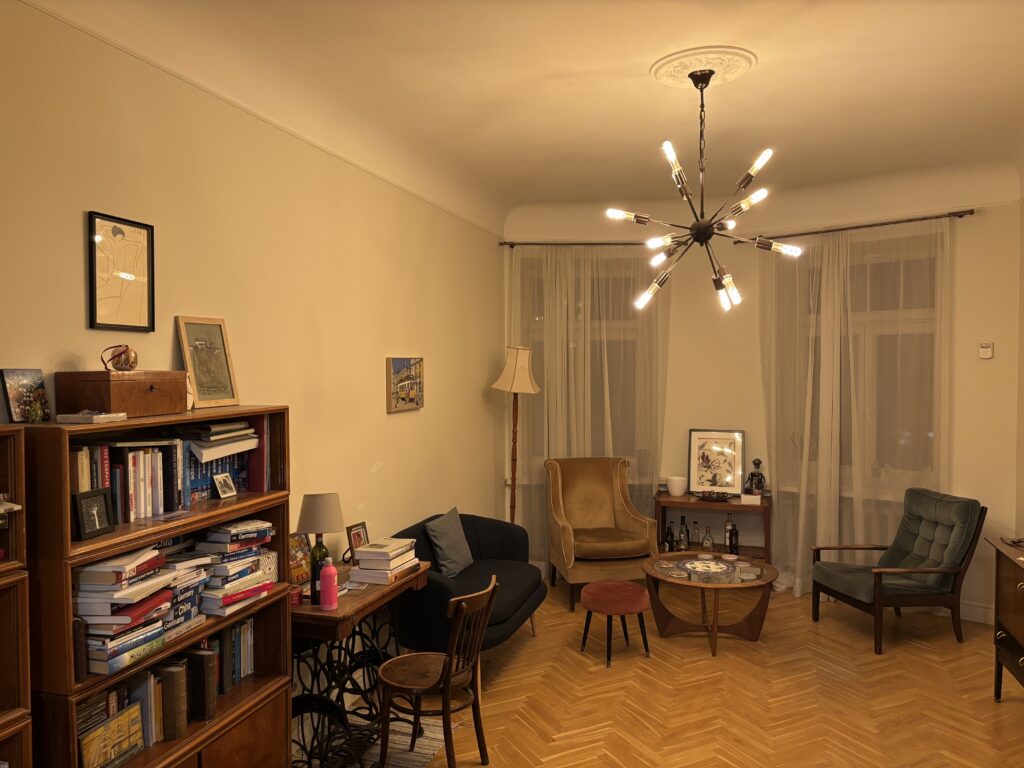
The living room in my Rīga apartment fills up with sunshine even during short winter days. It features parquet floors and some vintage 1960s furniture – book shelves I inherited from my Polish grandmother and a few items procured by a BBC friend for a few hundred quid at a London sale. There are pictures on the walls: Prints of Modigliani’s drawings of Anna Akhmatova (my Mom’s gift), a comics-styled picture of street life in Lisbon, a glass icon from Romania and a large poster by Valery Chtak which proclaims: “Auselkis is Toleze” (both words mean Venus in Latvian and Udmurt languages).
Outside is my street lined with elegant Arte Nouveau edifices and quaint wooden houses – the world’s most beautiful street as far as I am concerned. Beyond is a smallish but beautiful country which I literally walked across on foot when I found myself locked inside it during the Covid emergency. I also traversed it through and through working on three editions of the Lonely Planet guide to Latvia.
Being kicked out of your only and most beloved home is not a calamity I wish upon any person, not even upon my persecutors. It is an act of cold-blooded violence, an act of terror. It takes a lot of courage to admit that I have emerged from this experience with a deep psychological wound.
But my wound is nothing compared with what these people and organizations do – together with Putin’s regime – to Ukrainians. For a few years now, I’ve been watching revolting videos of Ukrainians being snatched by press gangs in the street while shopping or walking their dogs and sent to die in stinky trenches. These come up every day, and they do reinforce my witness trauma, just like death porn from drones and bodycams posted by psychopathic info warriors on both sides of the conflict.
As I wrote this essay, a contact in Kyiv, a major Ukrainian intellectual, re-emerged after disappearing off the radar for weeks, to say that he’s been mobilized. Just like when I think about the plight of my ancestors, I feel as if I could have fared much worse than losing my home.
As I am writing this essay, I am realizing two things about myself. Firstly, how difficult it is to make oneself describe a deeply traumatizing experience and create a coherent narrative about it. Secondly, it is overcoming the sense of shame, isolation, self-depreciation – all the symptoms born out of the years of gaslighting by malign actors who simply wanted to shut me down and break my will. “Trauma shames and isolates; the foundation of recovery is therefore in restored relational connections,” writes Hermann.
What I observed in recent years is intellectuals, who found themselves traumatized in various ways by the warmongering sect, flocking together. It was a very difficult process – stigmatized people are afraid of stigmatizing others or being further stigmatized by association with other carriers of stigma.
I found particularly rewarding that my views on the war were resonating particularly well with Ukrainians who preserved their moral compass and didn’t succumb to the war propaganda that’s destroying their own country in the lucrative joint venture with Putin. My dissident network has been also filling up with Western academics and humanitarian workers, Russian independent journalists and antiwar activists and many other people.
In her book, Judith Herman emphasized that every major breakthrough in the science of trauma and recovery has resulted from broad political movement – feminist, antiwar or anti-racist. In the epilogue to later editions, in 2015 and 2022, she laments that such movements are virtually absent today.
She links it to something I touched upon and got badly bruised for in many of my articles: the capture of the discourse and state institutions by securocratic elites who consolidated their power almost simultaneously in the West and Russia – around the time of the 9/11 attack and Putin’s ascent to the presidency.
Speaking about the US, she described how the war machine (now worth a whopping trillion dollars, if you look at the Pentagon’s annual budget) has learned to play on people’s propensity for dissociation. Since the Vietnam war debacle, the West’s multiple wars have been removed from public scrutiny by abolishing the draft, using proxy forces (Ukraine is the most poignant example), and the broad use of hybrid methods, particularly infowar, which targets domestic audiences and individual citizens/residents of Western countries, such as myself, at least to the same extent as people in hostile societies.
A broad and powerful antiwar movement is vitally needed today in order to restore a safe space to talk about the origins of conflicts such as the Russo-Ukrainian war beyond essentialist mythology peddled by warmongers. It is also necessary for societies to end hypocritical virtue signaling that creates a false sense of moral righteousness, but in reality perpetuates the ongoing violence. People must be taken out of their comfort zone and shown what horrors their complacency and dissociation creates all around the world.
Leonid Ragozin is an independent journalist, currently homeless.